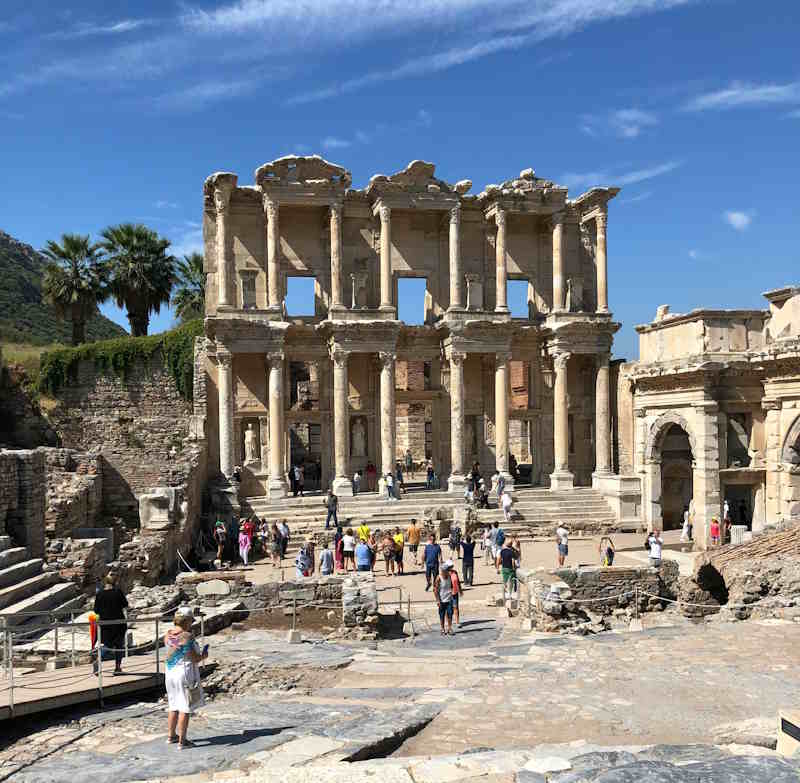
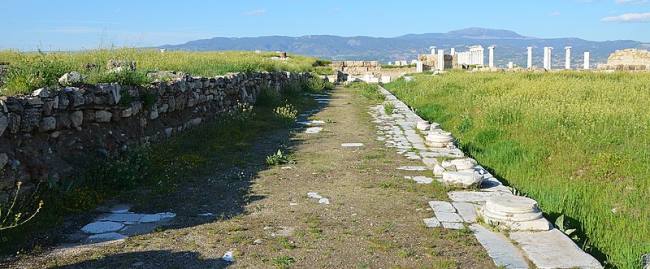
Travelers come to us having read the seven letters, and almost the first thing they ask is the same: but what is the rest of this book? The letters in chapters 2 and 3 feel grounded — real cities, real problems, plain enough to follow. Then the book opens up into seals and trumpets and a woman clothed with the sun, and many readers quietly close it again. So before we walk the seven churches, let us try to do something simple: explain, in plain terms, what the Book of Revelation actually is, and where those seven letters belong inside it.
We are not theologians. We are guides who have read this book in the places it names, year after year. What follows is the short orientation we wish someone had given us at the start.
A Letter, a Prophecy, and an Apocalypse
The book calls itself three things, and all three matter. Its very first word, in Greek, is apokalypsis — an "unveiling," a pulling-back of the curtain. That is where we get the word apocalypse, which today wrongly suggests only catastrophe. To John it meant disclosure: something hidden being shown.
It also calls itself a prophecy — not mainly a forecast of dates, but a word spoken into a community's present, the way the Hebrew prophets spoke. And it is framed as a letter, sent to seven named congregations, with a greeting and a blessing and a close, exactly like Paul's letters. Hold those three together and the book stops being a puzzle box. It is a pastoral letter, written in the visionary language of apocalypse, carrying a prophet's word to real churches under pressure.
Who Wrote It, and When
The author names himself plainly — John — and writes from exile on Patmos, an island off this coast, during a time of pressure on the churches of Asia. The strong early tradition identifies him with the apostle John, who spent his last years at Ephesus; some scholars distinguish a separate "John the Elder." We leave that debate to others. What is not in doubt is that the writer knew these seven cities intimately, from the inside.
The usual date is around the year 95, late in the reign of the emperor Domitian, who pressed the imperial cult harder than most. That dating is not modern guesswork — it goes back to Irenaeus, a bishop writing within a century of the events, who says the vision was seen "towards the end of Domitian's reign." That setting is not background trivia. It is the pressure the whole book answers — a small, poor movement being asked, in a hundred daily ways, to bow to the power of Rome, and being shown, in vision, who actually sits on the throne.
How the Book Is Built
Here is the shape, in the plainest terms we can manage. It helps enormously to have it in your head before you read.
Chapter 1 is the opening vision: John, on Patmos, sees the risen Christ standing among seven golden lampstands, and is told to write to the seven churches.
Chapters 2 and 3 are the seven letters themselves — the part this whole site is built around. They are the most concrete, down-to-earth section of the book, each one addressed to a real congregation in a real town.
From chapter 4 onward the curtain lifts. John is shown the throne room of heaven, and then a long sequence of visions unfolds in sevens — seven seals, seven trumpets, seven bowls — full of cosmic upheaval, a great beast, a city called Babylon that stands for Rome, and finally the fall of that city.
And it ends, in the last two chapters, not in destruction but in renewal: a new heaven and a new earth, and a holy city coming down with the river of life and the tree of life, the very tree that was lost at the beginning of the Bible, given back.
How to Read It Without Getting Lost
The single most useful thing we can tell a first-time reader is this: Revelation is written in images, not in code. The symbols are not a locked cipher with one secret solution. They are pictures drawn almost entirely from the Hebrew scriptures — Daniel, Ezekiel, Exodus, the Psalms — reworked into a single vision. A reader soaked in the Old Testament, as John's first hearers were, would have recognized the furniture immediately.
So the beast is not a riddle to be matched to a modern politician. It is the face of arrogant worldly power in every age — and to John's readers, very specifically, Rome. Babylon is not a coordinate on a map. It is the great seductive city that thinks itself eternal. The numbers — seven, twelve, a thousand — are symbolic of completeness and fullness, not calendar arithmetic. Read this way, the book stops being a horoscope and becomes what it was meant to be: resistance literature for the persecuted, insisting that the empire is not as permanent as it looks, and that the Lamb, not Caesar, holds the future.
Why the Seven Letters Come First
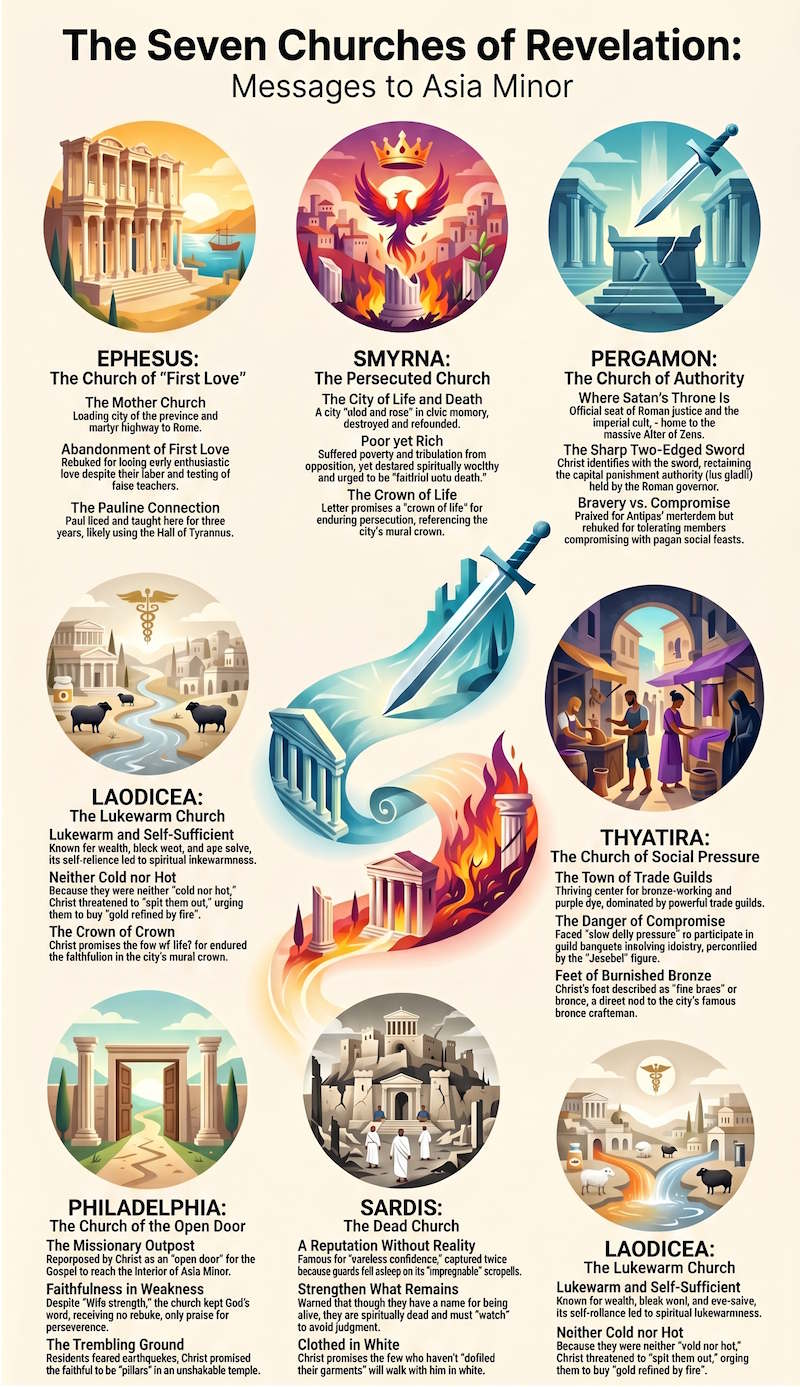
Notice the order. Before any of the cosmic visions, the book plants its feet in seven ordinary towns. Before the throne and the seals, there is Ephesus losing its first love, Smyrna facing prison, Laodicea drinking its lukewarm water. The grand vision is anchored, first, in the concrete and the local.
We have always found that deeply reassuring, and deeply practical. Whatever you make of the seals and the trumpets, the book begins by asking the same plain questions of seven real congregations that it would ask of any of us: Are you faithful? Have you grown cold? Are you only pretending to be alive? Are you too comfortable to hear a knock at your own door? You do not have to decode the beast to be searched by those questions.
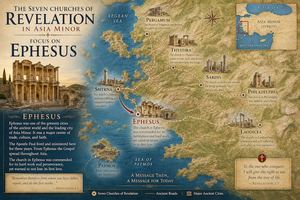
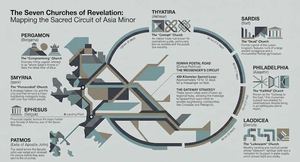
That is why the rest of this site lingers where the book itself begins — in the seven cities, all of them within a short drive of our home coast. The cosmic vision is real, and worth reading to its glorious end. But the doorway into it is seven letters to seven small churches on this coast, and that doorway is where we always start. Start there yourself with our full set of seven churches articles, or walk through the doorway in person on our Seven Churches of Revelation tour.
Gallery
Sources & Further Reading
- Revelation 1 (KJV) — the book’s own opening
- Revelation to John — Encyclopaedia Britannica — a scholarly overview of authorship and date
- Book of Revelation — Wikipedia — structure, genre and interpretation
- Daniel 7 (KJV) — the vision Revelation’s imagery leans on most