We spend so much time on the seven letters that we tend to skip the thing that gives them their authority. Before a single church is addressed, before Ephesus is praised or Laodicea is rebuked, John turns around in his cave and sees something. The whole rest of the book — and every one of the seven letters — flows out of that one vision in chapter 1. If you do not look at it first, the letters lose half their weight.
So let us do what our guides do with their groups when everyone has read too quickly: stop, go back, and look at what John saw before he wrote a word to anyone.
A Voice Behind Him
It begins with sound, not sight. John hears a great voice "as of a trumpet" behind him, telling him to write what he sees and send it to the seven churches. And then comes the line we always slow down on: "I turned to see the voice that spake with me." He turns. And what he sees first is not a face but seven golden lampstands, and walking among them, "one like unto the Son of Man."
That phrase — like a son of man — is not casual. It is lifted straight from the prophet Daniel, where a mysterious human figure is brought before the throne of God and given everlasting dominion. Every Jewish reader would have caught the echo at once. The figure in the cave is being identified, by the borrowed language alone, as the one to whom all authority belongs.
The Description, Piece by Piece
Then John piles up the details, and they are strange and deliberate: hair white as wool and snow; eyes like a flame of fire; feet like fine brass glowing in a furnace; a voice like many waters; seven stars in his right hand; a sharp two-edged sword coming out of his mouth; a face shining like the sun at full strength.
It is easy to read this as a jumble of weird images. It is anything but. Almost every detail is drawn from the Hebrew scriptures — the white hair of the Ancient of Days, the bronze and fire of Ezekiel and Daniel, the voice like rushing water. John is not inventing a monster. He is painting the risen Christ in the full visual language of divine glory, so that no reader could mistake who is speaking.
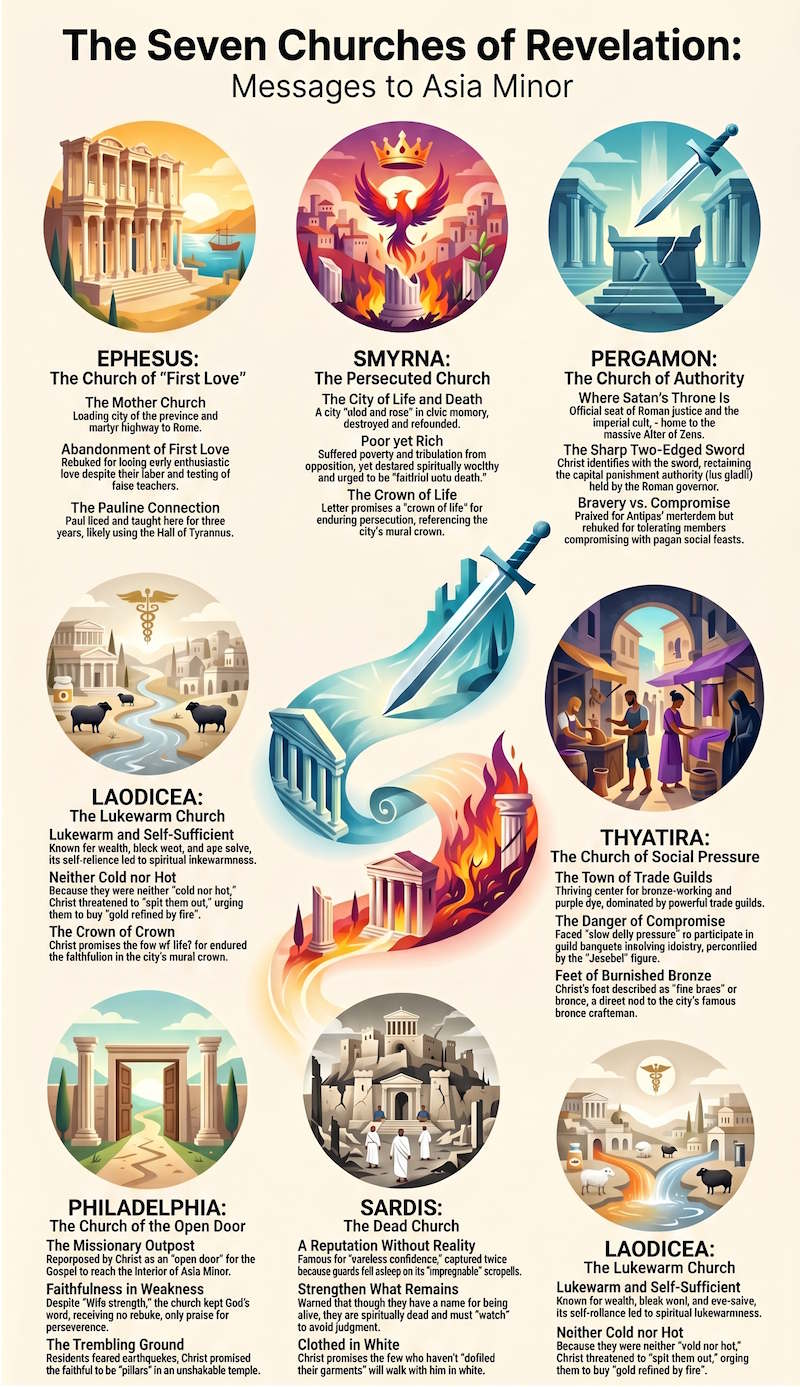
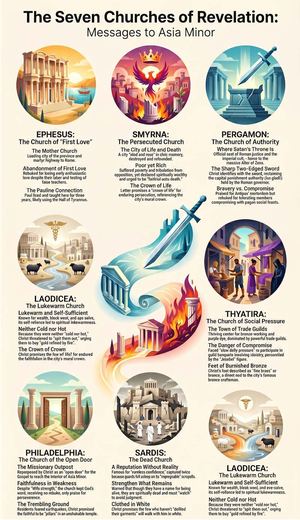
And here is the part we find quietly brilliant. Those same images are then handed out, one by one, to the seven cities. The one whose feet are like fine brass writes to Thyatira, a town of bronze-workers. The one with the sharp sword writes to Pergamon, the city of the Roman governor's sword. The one who is the first and the last, which was dead and is alive writes to Smyrna, a city that prided itself on having died and risen. The opening vision is the toolbox; each letter reaches in and pulls out the image that fits its town.
Lampstands and Stars
Two details in the vision are explained on the spot, and they matter more than any other. John is told plainly: "the seven stars are the angels of the seven churches: and the seven candlesticks which thou sawest are the seven churches."
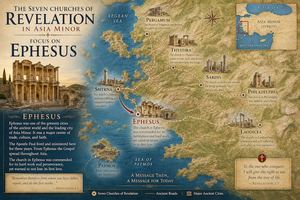
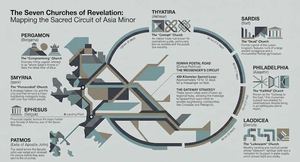
So the seven golden lampstands are the congregations — Ephesus, Smyrna, Pergamon, Thyatira, Sardis, Philadelphia, Laodicea. The image itself has old roots: the prophet Zechariah had already seen a golden lampstand as the sign of God's presence with his people. And the figure of Christ is standing in the midst of them. Sit with that for a moment. Before he says one word of praise or warning, before he threatens to remove a single lampstand, he is already there, among them, holding their stars in his hand. The inspection that follows in chapters 2 and 3 is not the inspection of a distant landlord. It is the scrutiny of someone already standing in the room.
The seven stars held in his right hand are called the angels of the churches — which most readers take to mean the guardian spirits, or the leaders, of each community. Either way, the picture is the same: the churches are not adrift on the edge of a hostile empire. They are held.
Why John Falls Down
The vision ends with John's own reaction, and it is the most human moment in the chapter: "when I saw him, I fell at his feet as dead." This is not poetry. A man overwhelmed simply collapses. And then comes the gesture we love most in the whole book — the figure lays his right hand, the same hand that holds the seven stars, on the terrified old man and says, "Fear not."
Fear not; I am the first and the last: I am he that liveth, and was dead; and, behold, I am alive for evermore.
That sentence is the hinge of the entire Apocalypse. The book that is about to unfold seas of fire and falling stars and a great beast opens with fear not, spoken by one who has himself been through death and out the other side. Everything harsh that follows — and there is plenty — is framed by that opening reassurance.
Reading the Letters in Its Light
When we take people through the seven letters now, we always begin here, with the vision they almost skipped. Because once you have seen Christ standing among the lampstands, holding the stars, scarred but alive and unafraid, the letters change character. The warnings stop sounding like threats from outside and start sounding like the words of someone who is already inside the house, who knows it intimately, and who has not left.
If you want to see where this vision leads, read it alongside the seven promises that close each letter, or the short guide to the Book of Revelation for how chapter 1 fits the whole. And if you would like to stand in the cities these lampstands once lit, browse every article on the seven churches, or join our Patmos day tour to stand where the vision itself was seen.
Gallery

Sources & Further Reading
- Revelation 1 (KJV) — the opening vision itself
- Daniel 7 (KJV) — the “one like a son of man” before the Ancient of Days
- Zechariah 4 (KJV) — the prophet’s vision of the golden lampstand
- Son of man — Wikipedia — the background of the title