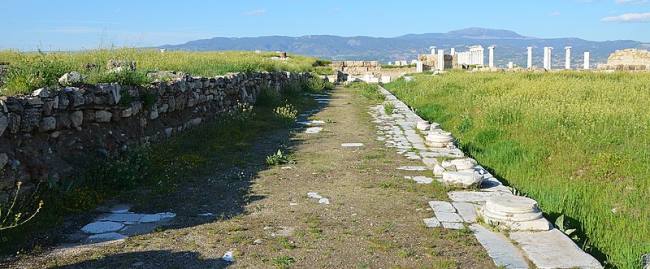
Before any of the seven letters reached its city, the words were received on a small, dry island in the Aegean — close enough to this coast that on a clear day our guests ask whether the smudge of land on the horizon is it. Often it is. Patmos lies about sixty kilometers off the Turkish coast, an easy crossing by sea, and it belongs to Greece today. But in the first century it was simply one more rocky outpost of the Roman province of Asia, and it was used for the purpose Rome used such islands for: to put inconvenient people somewhere out of the way.
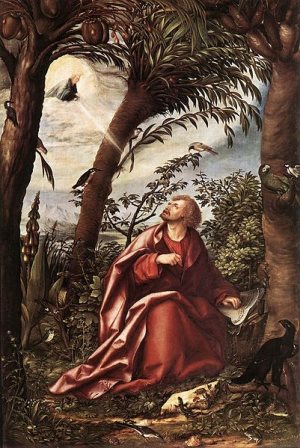
The writer tells us so himself, plainly, without drama: "I John... was in the isle that is called Patmos, for the word of God, and for the testimony of Jesus Christ." He was there because of what he preached. He was, in the technical Roman sense, in exile.
What Roman Exile Actually Was
We should not picture a prison. Roman law had two main grades of banishment. The harsher kind stripped you of citizenship and property. The lighter kind, relegatio, simply removed you from a particular place and confined you to another — you kept your status, you were not chained, you could move about, talk to the locals, receive visitors, and write. The punishment was isolation itself, and the difficulty of staying connected to the communities you had been stirring up on the mainland.
That is almost certainly the situation behind Revelation. An old man — by the strong early tradition, John, the last living member of the first generation of apostles — is removed from Ephesus and set down on a quiet island, late in the reign of the emperor Domitian, around the year 95. He is not being tortured. He is being silenced by distance. And from that silence comes the noisiest book in the Bible.
The Cave
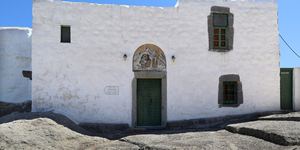
Tradition fixes the place of the visions in a cave on the hillside between the harbor at Skala and the hilltop town of Chora. Today that grotto is enclosed within a Greek Orthodox monastery, the Holy Cave of the Apocalypse, and pilgrims have been coming to it since the early Byzantine centuries — the cave, the hilltop monastery and the old town around them are together protected as a UNESCO World Heritage Site. Inside, visitors are shown a hollow in the rock said to be where John rested his head, a handhold where he pulled himself up, and a triple cleft in the ceiling said to have opened at the moment he heard the voice "as of a trumpet."
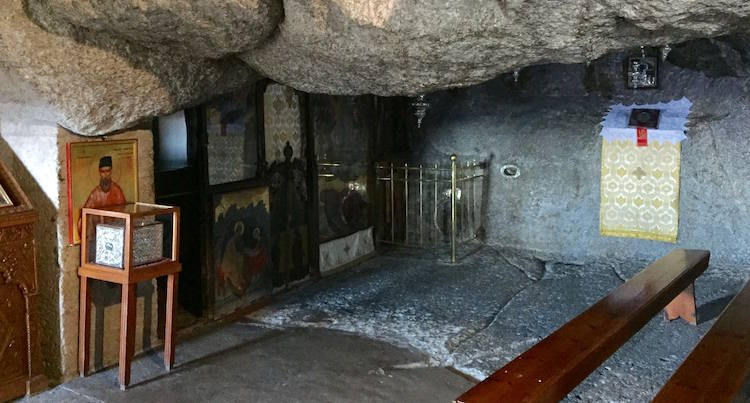
We are careful, when we describe this, not to tell anyone what to believe about every detail. What we will say is that the cave is real, the island is real, and the experience of being there is unlike reading the text anywhere else. The light, the bare stone, the long horizons of sea and sky — all of it is in the book. The sea like glass mingled with fire, the riders on the open plain, the holy city coming down out of heaven across a great brightness of water: Revelation is written in the visual language of a small Aegean island in summer. The geography is not a backdrop to the vision. It is the vision's vocabulary.
How a Book Gets Written in Exile
People rarely stop to think about the sheer practicality of it. Revelation is long — twenty-two dense chapters, thick with imagery, quoting and echoing the Hebrew scriptures on almost every page. To produce a text like that, an old man on a penal island needed ink, writing material, time, and an enormous library held inside his own memory.
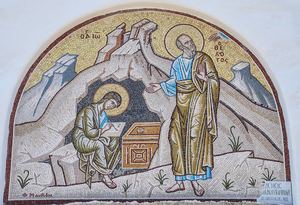
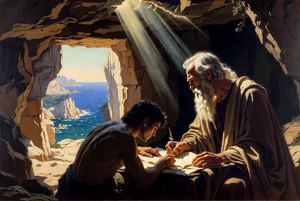
The Eastern tradition remembers a companion: a younger disciple named Prochorus, who served as the scribe, holding the pen while John dictated what he saw. Whether or not every detail of that tradition is historical, it captures something true — a book like this is the work of a partnership and a process, not a single ecstatic afternoon. The visions came; they were spoken; they were written down; they were ordered into the shape we now have.

Getting the Book Off the Island
Then came the hardest part: the words had to travel. A copy of the Apocalypse would have been wrapped against the damp, sealed, and entrusted to a Christian merchant sailing for Ephesus — the great harbor that was the natural first stop. From Ephesus more copies were made, and the circular letter began its journey around the seven cities: north to Smyrna and Pergamon, inland to Thyatira and Sardis, on to Philadelphia, and finally up the valley to Laodicea. The sea route that had carried John into exile now carried his words out of it.
After Patmos
Domitian was assassinated in the autumn of 96, and his successor reversed many of his orders. The tradition is consistent: John returned across that same stretch of water to Ephesus, lived his last few years there, and died of old age — the only one of the Twelve, most early sources agree, not to be martyred. He is remembered as being so frail at the end that he had to be carried into the gathering, where he would repeat one short sentence again and again: little children, love one another.
He is buried, by the early tradition, on the hill of Ayasuluk above the nearby town of Selçuk, where the emperor Justinian would later raise a great church directly over the tomb. Sixty kilometers of sea, and a single old man's journey there and back, connect the cave on Patmos to a hill half an hour from Kuşadası harbor. When our guests have seen both, that nearness is often what stays with them: a real man, a real island, a real text, written within sight of this coast, that has not stopped speaking in nineteen centuries.
Patmos Among the Seven Churches
Patmos is the odd one out among these pages. It is not a city of the mainland but a small island off the coast, about a hundred kilometers southwest of the harbor at Ephesus and some sixty kilometers from the nearest Turkish shore. Yet it belongs with the others completely, because it is where their letters began. From this rock John wrote to all seven at once: to Ephesus and Smyrna on the coast, to Pergamon in the north, and inland to Thyatira, Sardis, Philadelphia and Laodicea. The courier who carried the sealed book would have made landfall first at Ephesus, the nearest great port, and from there the message worked its way around the loop. Our Patmos day tour makes that same crossing, our Seven Churches and Patmos tour joins it to all seven cities, and the rest of the circuit the courier walked is set out in every article on the seven churches.
Gallery
Sources & Further Reading
- Revelation 1 (KJV) — John’s own account of the island and the vision
- Cave of the Apocalypse — Wikipedia — the traditional site of the visions
- Pátmos — UNESCO World Heritage Centre — the Chorá, the Monastery of Saint John and the cave
- John of Patmos — Wikipedia — the author, and the question of his identity