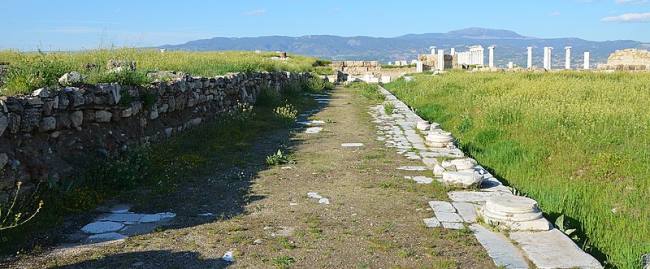
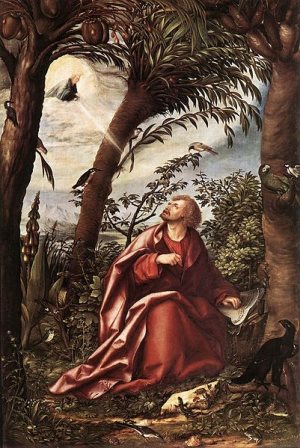
The church of Thyatira is the fourth of the seven churches of Revelation, addressed in Revelation 2:18–29 — the longest of the seven letters. The ancient city lies under modern Akhisar in Manisa province, where a single fenced excavation survives in the middle of the town. The letter commends the congregation’s growing love and rebukes it for tolerating the teacher it calls Jezebel.
We will be honest from the first line, the way our guides are with their groups: of the seven cities, Thyatira is the one with the least to see. The ancient town lies buried under modern Akhisar, a busy commercial centre of around a hundred thousand people, and the only openly visible piece of it is a small fenced excavation in the middle of the town, ringed by traffic, tea houses, and shoe shops. If you arrive expecting another Ephesus, you will be disappointed.
And yet Thyatira receives the longest of the seven letters — twelve verses, more than any other church. The smallest place, the longest message. That contrast is the whole point, and it is worth understanding.
A Working Town
Thyatira was never a grand Greek city. It began in the early third century BC as a Macedonian military colony, a garrison planted to guard the road between Pergamon and Sardis — somewhere to settle old soldiers and give them land. It sat on flat ground in a river valley, with no acropolis, no harbour, no spectacular setting. It was a flat, useful, working town.
What it had, in abundance, was trade guilds. Inscriptions from Thyatira name associations of dyers, wool-workers, linen-weavers, leatherworkers, potters, bakers, bronzesmiths, and more — the densest concentration of guilds known from Asia Minor. The whole social and economic life of the place ran through these professional bodies. The most famous of them were the dyers, who produced the city's celebrated purple — a madder-root dye that gave a deep red at a fraction of the price of true sea-purple. Thyatiran purple was the everyday purple of the Roman middle class.
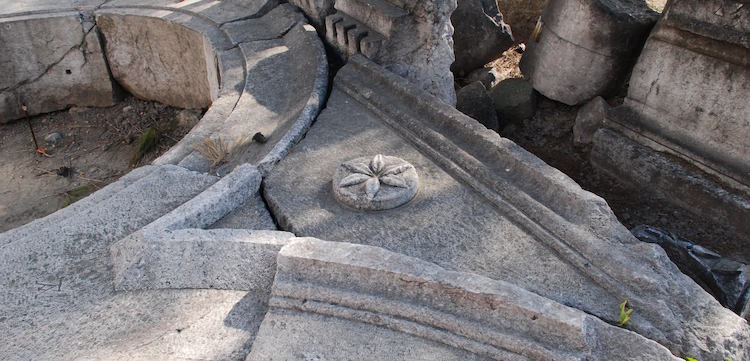
That trade reaches into the New Testament directly. When Paul meets a cloth merchant in Philippi in Acts 16 — Lydia, "a seller of purple, of the city of Thyatira" — he is meeting a woman running a Thyatiran operation in Greece. She becomes the first named European convert, and her network reached straight back to her hometown. It is very likely that Christianity entered Thyatira along the same purple-dye trade routes Lydia traveled.
The Guild Problem
Here is where the long letter comes from. The guilds were not only professional bodies — they were religious ones. Each had a patron god, regular sacrifices, and annual banquets where the meat had been offered in pagan rites and a cup of wine was poured out to the deity. For a Christian, this was a daily trap. To practise a trade, you generally had to belong to its guild. To belong, you were expected at the banquets. To attend, you ate the sacrificed meat and witnessed the libations. To refuse was to risk expulsion — and expulsion meant losing your living.
There was no easy middle path. Either you compromised and kept your job, or you held the line and lost it. That, and not some dramatic persecution, was the slow grinding pressure on the Christians of Thyatira.
The Letter: Growing Warmer
The letter opens with Christ "who hath his eyes like unto a flame of fire, and his feet are like fine brass." Both images are local. The eyes of fire are the eyes that see through every comfortable compromise. And the feet of fine brass point straight at the city's bronze guild — the Greek word used here is a rare technical term for a specifically Thyatiran metal. Christ presents himself to this town of craftsmen as, almost, a fellow craftsman: I know your trade, I know your products, my own feet are made of the bronze you make.
Then comes the praise, and it is the most encouraging in all seven letters: "I know thy works, and charity, and service, and faith, and thy patience... and the last to be more than the first." This is the exact opposite of Ephesus. Ephesus had cooled — its later works colder than its first. Thyatira was warming — its later works greater than its early ones. The community was growing in love, on an upward path.
And yet, inside this warm, growing church, there was a serious problem.
The Woman Called Jezebel
Notwithstanding I have a few things against thee, because thou sufferest that woman Jezebel, which calleth herself a prophetess, to teach and to seduce my servants.
The letter gives her the symbolic name of the Old Testament queen who brought foreign worship into Israel; her real name we do not know. What she taught, almost certainly, was a theology that solved the guild problem by removing it: the idols are nothing, so the banquet is only a meal — keep your guild, keep your income, attend the dinners, and keep your faith in private too.
It was, on the surface, a reasonable argument. Paul himself had said that idols are nothing and food is morally neutral. But Paul had added a sharp limit: even so, the public act of joining the idol's banquet is a different matter, a stumbling block. The Thyatiran prophetess seems to have kept the principle of freedom and dropped the limit.

We will add a quiet disagreement with the usual reading here. She is often painted as a wicked seductress. We suspect the truth is more uncomfortable: she was probably a sincere, respected teacher who was simply wrong about a serious practical question. That matters, because it is exactly the kind of error a real congregation faces — not an obvious villain, but a persuasive insider loosening the boundaries. And notice that Christ's response, though severe in its verdict, is patient in its method: "I gave her space to repent." The space was real. The judgment comes only after the patience is refused.
Hold Fast
To the rest — the faithful who had not taken the teaching — the words are gentle: "I will put upon you none other burden. But that which ye have already, hold fast till I come." No new demands. No heavier load. Just: keep what you have. Sometimes the Christian life is not about doing more. It is about not doing less.
The Morning Star
The promise is, we think, the most intimate of the seven. After a share in Christ's own authority comes this: "And I will give him the morning star." The morning star is Venus, the bright point that hangs in the east just before dawn — and later in the same book Christ calls himself the bright and morning star. So the gift to the faithful in this obscure working town is not a thing, or a place, or even a crown. It is Christ himself.
To the smallest, least famous, most pressured community of the seven, the most personal promise is given. The early Christians of Thyatira who had refused the guild banquets — who had lost income for their decisions — would have risen before dawn to walk to their workshops, and would have seen that same star in the east. It is still there every morning, before any of us wake. I will give him the morning star.
The Thyatiran Question
This is why the visit, even to a fenced patch of ruins among the shoe shops, is still worth making. The lesson of Thyatira is precisely about what is buried under the ordinary. Its ancient church lies under modern streets; its ancient compromise lay under ordinary daily commerce. Most of us will never face Smyrna's stadium. Almost all of us face Thyatira's banquets — the slow, unspectacular pressure of a thousand small compromises, with no single dramatic moment in which to be brave. Where you draw the line, how much you eat at the local table, when you finally say no — that is the Thyatiran question, and it has never stopped being asked.
Thyatira Among the Seven Churches
Thyatira sits inland between Pergamon, about fifty kilometres to the northwest, and Sardis to the south, a working town on the road that links the coast to the interior. It is the smallest of the seven cities and received the longest letter. Its closest parallel is Pergamon: both were warned not about persecution but about compromise, the quiet pressure to share in the pagan banquets. In that it stands apart from Smyrna and Philadelphia, which faced the open hostility of their neighbours rather than the temptation to blend in. The road from Thyatira runs on to Sardis, Philadelphia and Laodicea.
Gallery


Sources & Further Reading
- Revelation 2:18–29 (KJV) — the longest of the seven letters
- Acts 16 (KJV) — Lydia of Thyatira, the seller of purple
- Lydia of Thyatira — Wikipedia — the first named European convert
- W. M. Ramsay, The Letters to the Seven Churches of Asia (1904) — the classic on-the-ground study of the seven cities