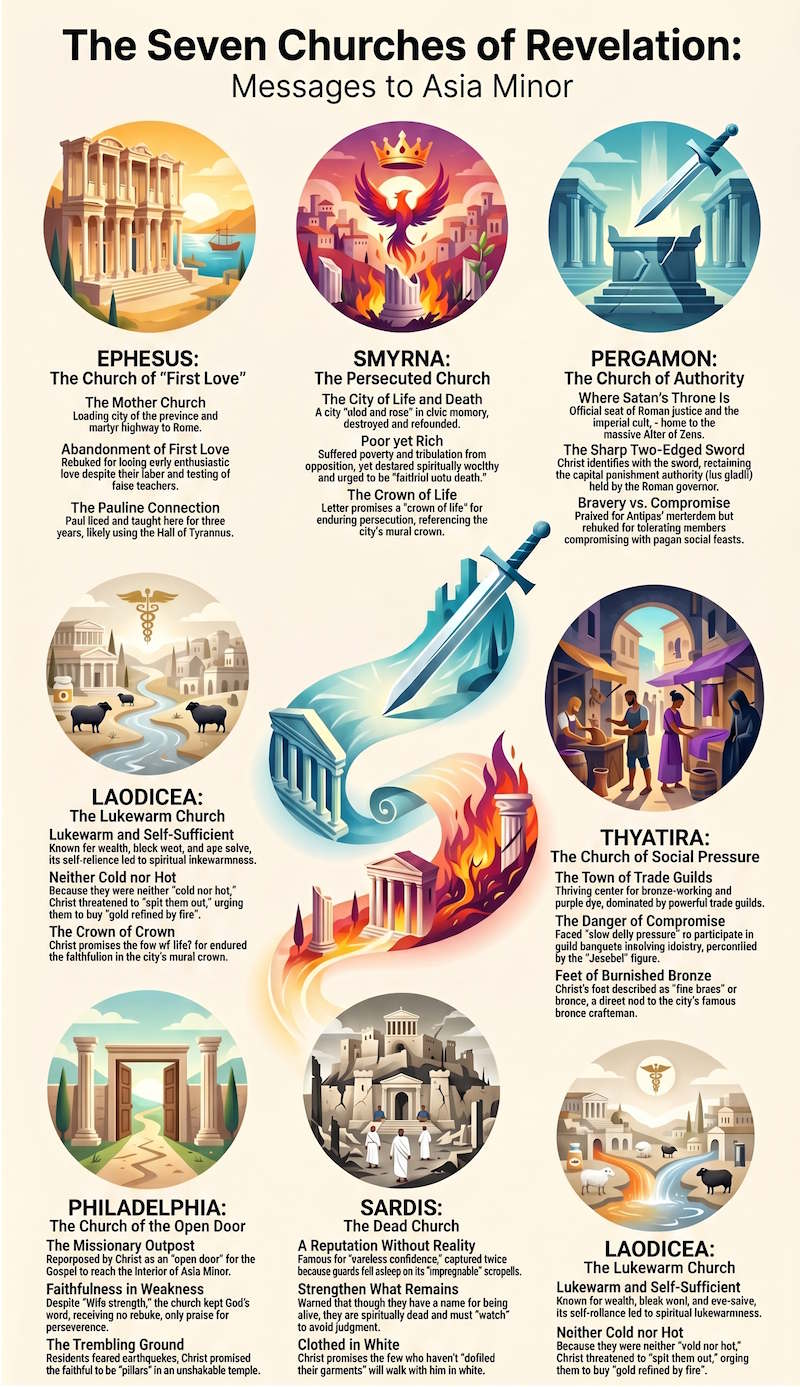
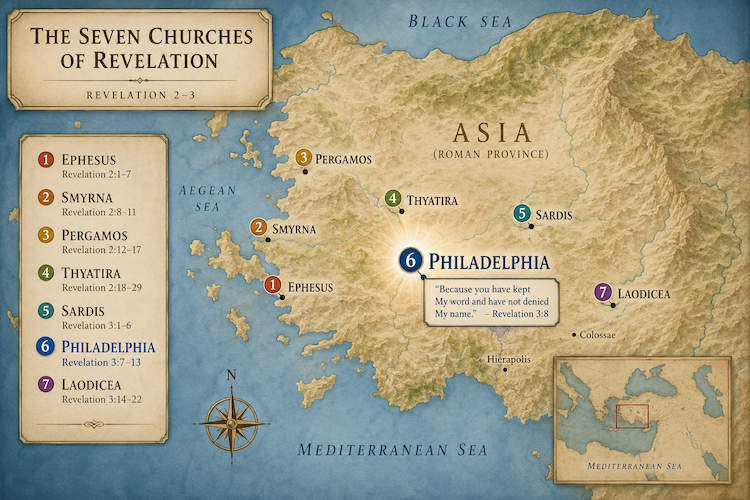
The question our team is asked more than any other is simply: can you actually visit all seven? Yes. All seven churches of Revelation stand in western Turkey, all seven can be reached on modern roads, and the whole circuit fits comfortably into a few unhurried days. What surprises people is how close together they are. The seven cities sit inside a rough loop barely two hundred kilometres across — exactly the kind of circuit a first-century courier would have walked, carrying the letter from one congregation to the next. The order in the Book of Revelation is, almost certainly, the order of that road.
We want to walk you through that loop the way our guides do on the ground, with an honest word about what is worth your time at each stop. This is a description of the route, not a sales pitch — if you would like to do it in person, we run it as a guided tour, but everything here stands on its own.
Why the Order Is What It Is
Open a map and plot the seven in the sequence John gives — Ephesus, Smyrna, Pergamon, Thyatira, Sardis, Philadelphia, Laodicea — and a clockwise ring appears. You start at the great harbour of Ephesus on the coast, run north up the shore through Smyrna to Pergamon, swing inland and come back down through Thyatira, Sardis and Philadelphia, and finish in the Lycus valley at Laodicea before the road heads back toward Ephesus. It is not a spiritual code. It is a postal route. The scholar William Mitchell Ramsay worked this out on the ground in the 1880s, and his account of the road has never really been bettered. Once you have seen it on a map you cannot un-see it, and the geography quietly settles a lot of old arguments about why these seven and in this sequence. If you want the loop laid out plainly — each church, the modern town it stands in, and the distance to the next — see our seven churches map and location table.
Ephesus and Its Coast (Stops 1 and 2)
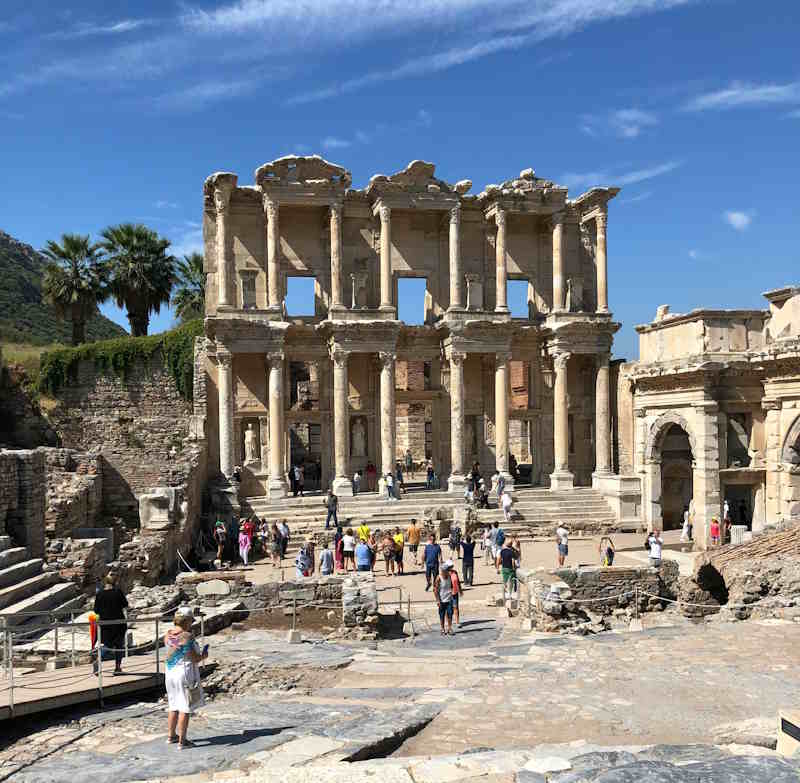
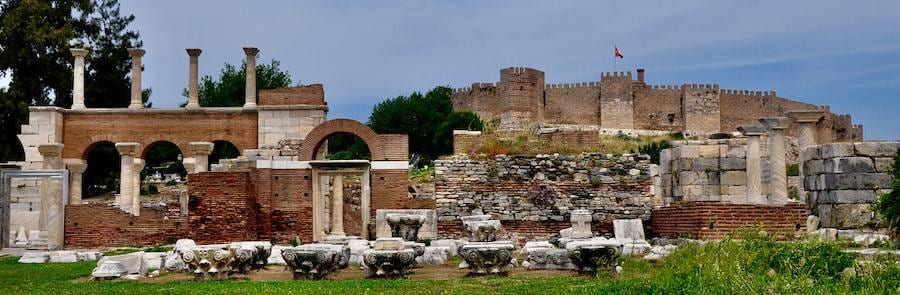
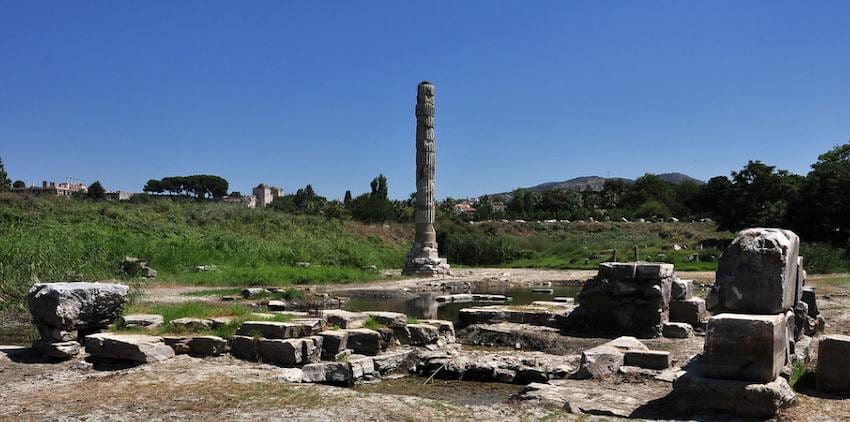
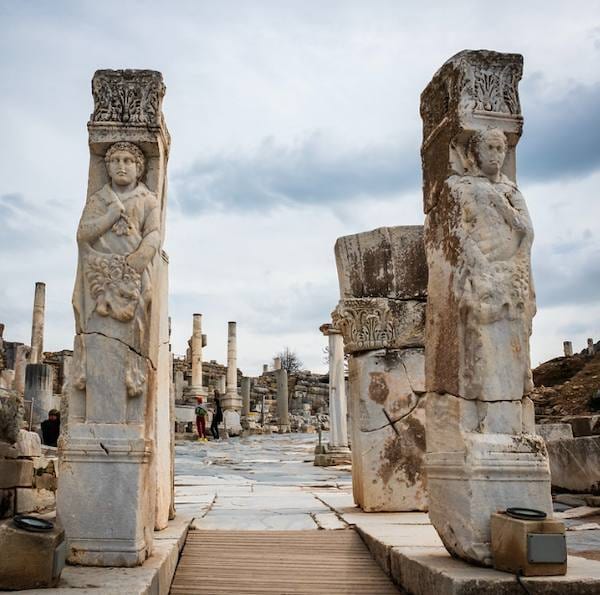
Begin where the letters began their journey: Ephesus, near modern Selçuk, the best-preserved ancient city in the Mediterranean, a UNESCO World Heritage Site, and the natural first stop. Give it most of a day. Curetes Street, the Library of Celsus, the great theatre where the silversmiths rioted, and up on the hill of Ayasuluk the ruins of the Basilica of Saint John over the apostle's tomb — there is more first-century Christian history here than almost anywhere outside Jerusalem.
An hour north is Smyrna, which never died — it is modern İzmir, four million people living on top of the old city. The agora is excavated in the city centre, and Kadifekale, the old citadel hill, gives you the whole sweep of the gulf. Of all seven, this is the one you meet as a living city rather than a ruin, which is oddly fitting for the church promised that it would not be hurt by the second death.

Pergamon, the High City (Stop 3)
About two hours further north stands Pergamon, modern Bergama — itself a UNESCO World Heritage Site — and for sheer drama it is the most theatrical site of the seven. The acropolis rises more than three hundred metres above the town, crowned by the steepest theatre in the ancient world and the foundations of the great Altar of Zeus — the "Satan's throne" of the letter. A cable car carries you to the top. Below the hill lies the Asclepion, one of the most famous healing sanctuaries of antiquity. Allow a full half-day; the climb and the views deserve it.

The Inland Swing: Thyatira, Sardis, Philadelphia (Stops 4, 5, 6)
Now the road turns inland, and the character of the trip changes. These three are quieter, less visited, and in our experience all the more rewarding for it.
Thyatira, under modern Akhisar, is the most modest of the seven — a fenced excavation in the middle of a busy town. We never pretend otherwise. But it is the city of the longest letter, and standing in that small patch of ruins among the shops, reading those twelve verses, has its own quiet weight.
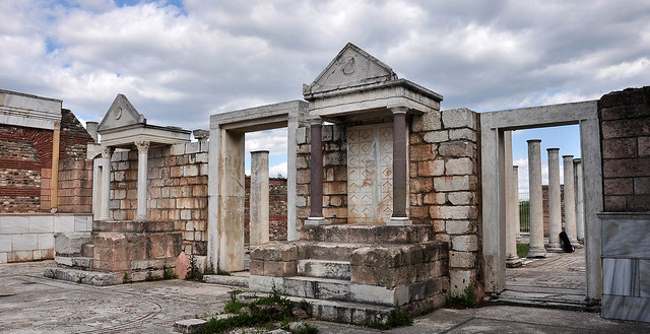
Sardis, near Salihli, is the opposite — one of the most haunting sites in the country. The blazing white Marble Court, the vast ancient synagogue beside it, and a short drive away the unfinished Temple of Artemis with two columns still standing under the cliff of the old acropolis. The wind never stops here. Give it a couple of hours.
Philadelphia, in the middle of modern Alaşehir, is mostly a few towering brick pillars of a Byzantine church, broken at the top, still upright after fifteen centuries of earthquakes — which is exactly the image the letter promised. It is a short visit, but a moving one if you know the verse.
Laodicea and the Lycus Valley (Stop 7)
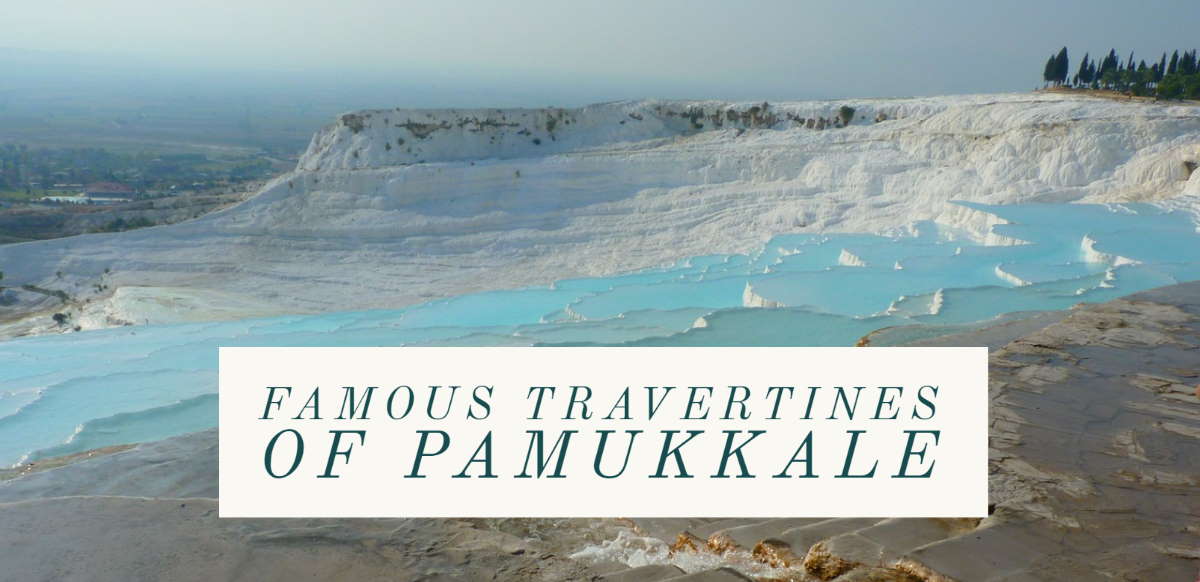
The loop closes in the Lycus valley with Laodicea, just north of Denizli — and it has become, after years of major excavation, one of the most spectacular open-air sites in Turkey. Marble streets, two theatres, a stadium, churches, and the stretch we always stop at: the old stone water pipes with the calcium crust still rough under your finger, the physical proof of the "lukewarm" metaphor. Across the valley you can see the white terraces of Pamukkale — ancient Hierapolis, the hot-water city of the letter's imagery, and a third UNESCO site on this same route.
How Long, and When
A focused circuit of all seven is comfortable in four to five unhurried days, starting and ending around İzmir or the Ephesus coast. People who only have a single day usually choose Ephesus and Smyrna, the two coastal stops, and that is a fair compromise — but the inland three are where the route stops feeling like sightseeing and starts feeling like reading the letters with your feet.
As for timing: spring and autumn are kindest. April, May, September and October give you mild light and quiet sites. High summer is hot and hard, especially at the exposed inland ruins like Sardis and Laodicea, where there is almost no shade — go early in the morning if you must go then. Winter is cool and very quiet, and the low sun on the marble at Ephesus can be beautiful.
A Closing Word
What stays with most people is not any single ruin. It is the connectedness — the realisation that these were not seven abstractions but seven real towns on one real road, close enough that a single letter could make the round in a matter of weeks. Read the seven letters in Revelation 2 and 3, then trace the loop on a map, and the passage stops being a mystery and becomes a journey. It is, we think, the best way to understand it. And if you would like licensed local guides to walk it with you, that is exactly what we do — but the road is there for anyone, with or without us.
Gallery


Sources & Further Reading
- Ephesus — UNESCO World Heritage Centre — the first stop of the circuit
- Pergamon — UNESCO World Heritage Centre — the acropolis at the northern turning point
- Hierapolis–Pamukkale — UNESCO World Heritage Centre — the white terraces beside Laodicea
- Seven churches of Asia — Wikipedia — an overview of all seven sites