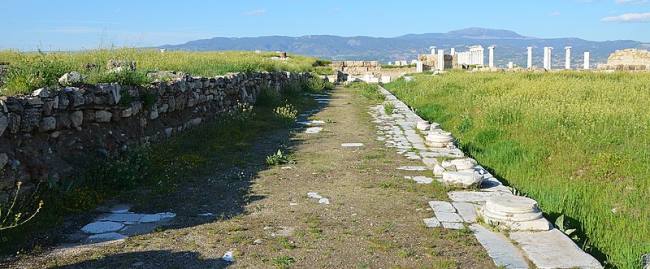
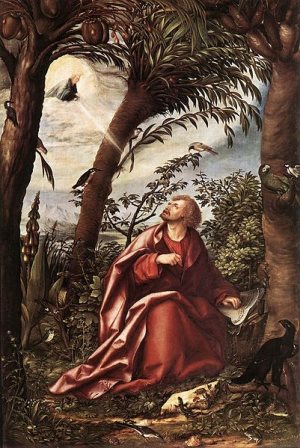
The church of Sardis is the fifth of the seven churches of Revelation, addressed in Revelation 3:1–6. The site lies at Sart near Salihli in Manisa province, where the Marble Court and the largest ancient synagogue ever excavated still stand. Sardis receives the harshest verdict of the seven: "thou hast a name that thou livest, and art dead."
Of the seven cities, Sardis is the one that quietly breaks our guides' hearts. That may not be a professional thing to admit, but certain places grow into you, and Sardis is the one where voices always drop a little. Maybe it is the wind on the acropolis, or the two lonely columns of the half-collapsed Temple of Artemis, or the harshness of the letter. Sardis was a city that lived off its memories, and the letter it received is built on that fact, line by line.
The Capital of Lydia
Sardis was ancient long before Christ. It had been the capital of Lydia — the kingdom of Croesus, proverbially the richest man of the ancient world. The Lydians were the people who, around 600 BC, invented coined money, minting the first true coins from the gold-and-silver electrum they refined from the sands of the little Pactolus stream that still crosses the ruins. Sardis was wealthy, sophisticated, a bridge between the early Greek world and the deeper Anatolian east. Croesus himself paid to rebuild the Temple of Artemis at Ephesus.
But the city carried a peculiar flaw through its history: it kept being captured by surprise. Its acropolis sat on a steep hill with cliffs on three sides, and the defenders thought it could not be climbed — so they left it unguarded. In 547 BC — the story is told by Herodotus — a Persian soldier watched a Lydian climb down the cliff to retrieve a dropped helmet, traced the path, and led a party up it that night; the upper city was undefended, and Sardis fell, Croesus with it. Then in 218 BC, almost exactly the same thing happened again — a different attacker, the same unguarded cliff, the same nighttime climb, the same fall. The Sardians became famous as the people who do not learn from their own history, who sleep on their own watch.
Every Sardian child grew up hearing those stories. Keep them in mind, because the letter is about to use them like a blade.
A Rebuilt City
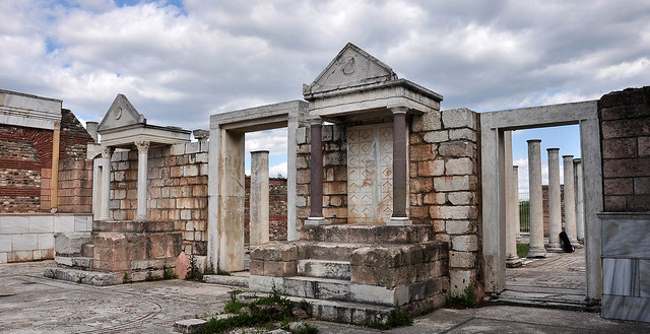
There is one more piece of background. In AD 17 a massive earthquake destroyed Sardis and eleven neighbouring cities. The emperor Tiberius funded the rebuilding and excused the city from taxes for five years. So the Sardis that John knew, around AD 95, was a relatively new city raised on the buried ruins of an old one — prosperous on the surface, but in some sense hollow. It had the form of greatness without the substance. That, too, is in the letter.
What Survives
The site today, near the modern village of Sart, has two main parts a kilometre apart. The first is the great gymnasium-and-synagogue complex. Its reconstructed marble façade — the Marble Court — blazes white when the morning sun hits it, pieced back together by the Archaeological Exploration of Sardis, the Harvard–Cornell expedition that has worked the site since 1958. Attached to it is the synagogue of Sardis, one of the largest known from the ancient world, with its menorahs carved in stone and its Hebrew inscriptions still in place. Its sheer size tells you that the Jewish community here was large, confident, and woven into the civic life of the city — which made the relationship between Jews and Christians in Sardis especially close, and especially complicated.

The second part, a short drive away at the foot of the acropolis, is the Temple of Artemis — unfinished in antiquity, but once among the largest in Anatolia. Two of its columns still stand complete with their capitals, the Pactolus stream runs nearby, and on a quiet morning the only sounds are the wind, the goats, and a distant rooster.

The Letter: A Name, but Dead
Christ introduces himself to Sardis as the one who has "the seven Spirits of God" — the fullness of the Holy Spirit. For a church that is spiritually dying, that is exactly the right introduction: the one writing to you is the one who can pour life back in. The diagnosis that follows, though, is the harshest sentence in all seven letters, and it comes with no praise at all before it:
Thou hast a name that thou livest, and art dead.
The Sardian church had a reputation for being alive. From the outside, all looked well — probably numerous, probably prosperous, not visibly persecuted like Smyrna, not visibly tempted like Thyatira. But Christ, who sees the heart, calls it a corpse that is still walking. This may be the most frightening diagnosis of the seven, because it is the one that can be missed by everyone, including the patient. A persecuted church knows it is suffering. A compromising church knows, somewhere, that it is compromising. A dead church may not even know it is dead.
Wake Up
The first command is pointed almost cruelly at the city's history: "Be watchful." Become a watchman — to the one town in the world most famous for the watchman who fell asleep. "Strengthen the things which remain, that are ready to die." The fire is not out; there are still embers; this is a wake-up call, not a death certificate — but only if the waking happens now. And then the warning lands on the oldest wound in the city's memory: "If therefore thou shalt not watch, I will come on thee as a thief, and thou shalt not know what hour I will come upon thee." The thief who climbs the cliff at night, the very way the city had fallen twice before. You did not learn the first time, or the second. Do not let it happen a third.
The Few
Then, after the harshness, a softer note — and it is the heart of the letter for us: "Thou hast a few names even in Sardis which have not defiled their garments; and they shall walk with me in white." In a city of dyers and clothiers, a soiled garment was an unsellable one; a clean garment kept its value. A few, quietly, without notice, had kept themselves clean of the city's compromises.
Notice that the rescue is not collective. Christ is not saving the institution. He is saving individuals, by name — "a few names." And to the overcomer the promise is threefold: white raiment; a name that will not be blotted out of the book of life; and recognition before the Father — "I will confess his name before my Father, and before his angels."
What the Ruins Teach
Here is the thing we always notice, standing among those two columns with the wind in the dry grass. The Sardian church is gone. The community died; the lampstand was, in the end, removed; the warning of the letter was, in the end, fulfilled. But the few faithful names are not in the ruins. They are not on the inscriptions or the tourist plaques. They are somewhere else — in the book of life, confessed before the Father and the angels.
The dying institution is forgotten. The faithful individual is remembered. That is the deep theology of Sardis, and it is a useful theology for anyone who has watched a community decline. The institution may not survive. The faithful person is not lost. There is an old Anatolian saying that comes to mind every time: geç olsun, güç olmasın — let it be late, but let it not be impossible. Late, but not impossible. That is the whole hope of the letter to Sardis.
Sardis Among the Seven Churches
Sardis lies inland, about sixty kilometres south of Thyatira and fifty northwest of Philadelphia, roughly a day east of Smyrna on the coast. Its near neighbour Philadelphia makes the most striking contrast among the seven. The two cities are close on the map and worlds apart in the letters: Sardis a famous church that was spiritually dead, Philadelphia an obscure one that was faithfully alive. Sardis has more in common with distant Laodicea, the other comfortable, complacent congregation. Both Sardis and Philadelphia had been levelled by the same great earthquake and rebuilt; the difference the letters mark is not in their fortunes but in their faith.
Gallery


Sources & Further Reading
- Archaeological Exploration of Sardis — the Harvard–Cornell expedition excavating the site since 1958
- Sardis Synagogue — Wikipedia — one of the largest synagogues of the ancient world
- Revelation 3:1–6 (KJV) — the letter to Sardis
- Croesus — Wikipedia — the proverbially rich last king of Lydia