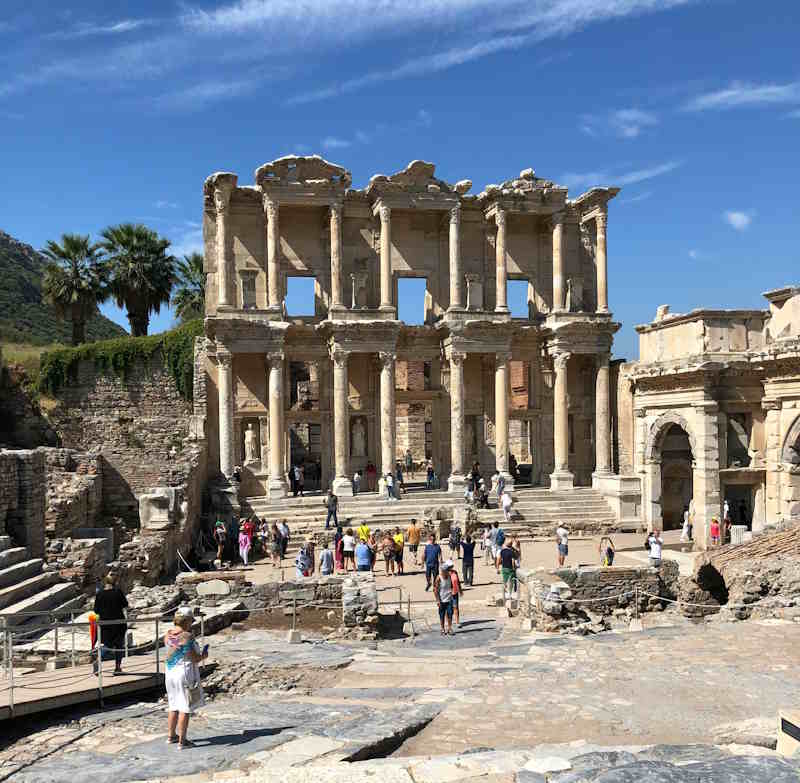
Most people read the seven letters for the warnings. The lukewarm church, the lost first love, the city that was dead while it thought it was alive — those are the lines that get quoted. But every single letter ends the same way, and the ending is almost always skipped over: a promise, addressed to "him that overcometh." Seven letters, seven promises. Read on their own, in order, they form a small ladder of their own, and we think they are the most overlooked part of the whole passage.
One of our guides started paying attention to them years ago, on a slow afternoon at Laodicea, when an elderly visitor asked to hear all seven endings read out loud, one after another, with nothing in between. It changes the whole tone of Revelation 2 and 3. The warnings are sharp, yes — but each one resolves into a gift. Let us take them in turn.
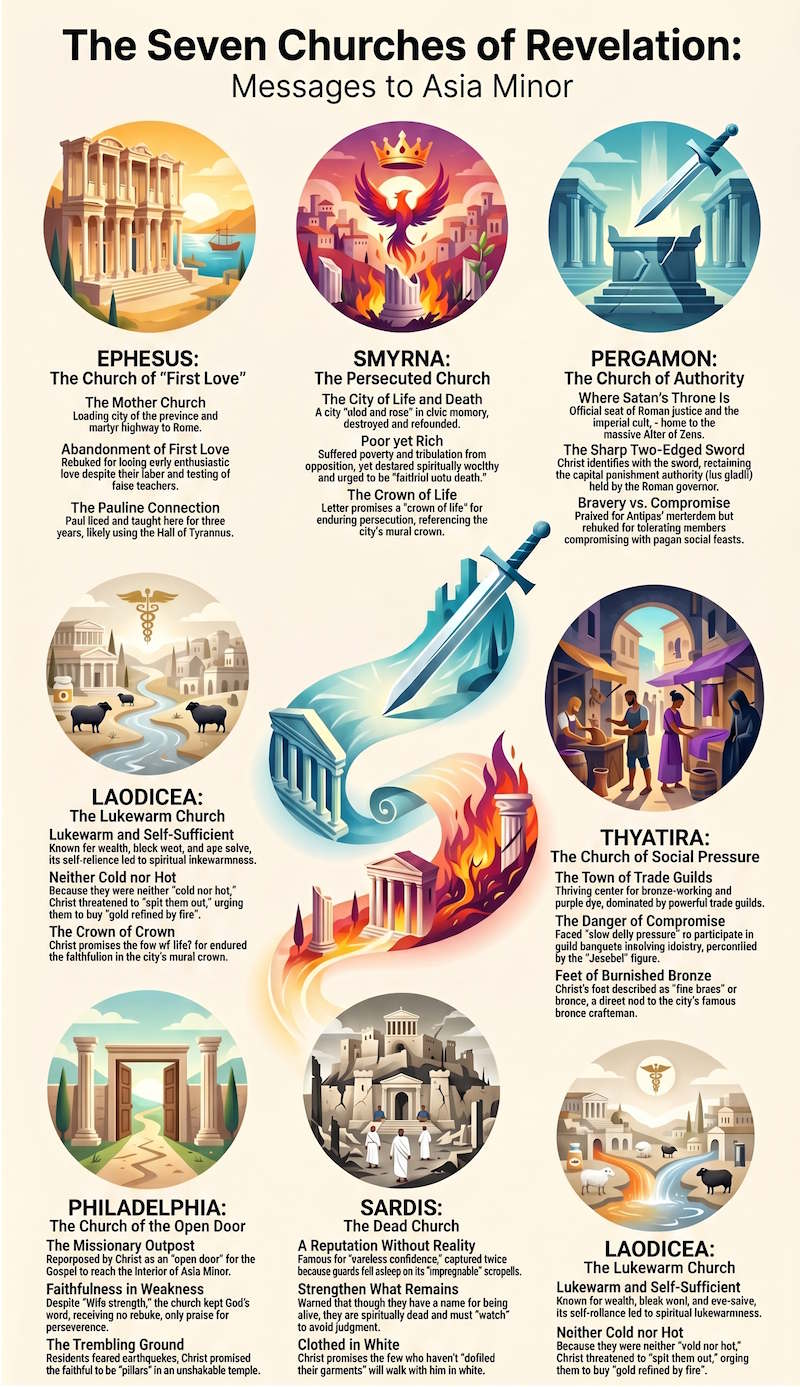
Ephesus — The Tree of Life
To him that overcometh will I give to eat of the tree of life, which is in the midst of the paradise of God.
The first promise reaches all the way back to the first pages of the Bible. Humanity was shut out of Eden and barred from the tree of life. Now, to the church that has fallen from its first love but can rise again, that very tree is offered back. The reward fits the rebuke exactly. Ephesus has fallen; the tree that was lost in the fall is held out again. The fall is not the end of the story.
Smyrna — The Crown, and Freedom from the Second Death
He that overcometh shall not be hurt of the second death.
To the church facing actual execution, the promise is not escape from death but immunity to the second death — the final, eternal loss. The empire can take the body. That is only the first death. It cannot touch the deeper life. For a congregation being told to be "faithful unto death," there is no more powerful sentence in the book.
Pergamon — The Hidden Manna and the White Stone
I will give to eat of the hidden manna, and will give him a white stone, and in the stone a new name written, which no man knoweth saving he that receiveth it.
Here the gift turns private. Against the public pagan banquets that the false teachers wanted the Pergamenes to attend, Christ offers a secret meal — the hidden manna of the kingdom — and a white stone bearing a name known only to its owner. Whatever the exact origin of the white stone (a juror's pebble of acquittal, a victor's banquet token, an inscribed amulet), the meaning lands: a different invitation, and an identity that no compromise could ever counterfeit.
Thyatira — Authority, and the Morning Star
And I will give him the morning star.
The fourth promise is, we think, the most intimate of the seven. After a share in Christ's own authority over the nations comes this: the morning star. Later in the same book, Christ calls himself the bright and morning star. So the gift to the faithful in that obscure working town is not a thing, or a place, or even a crown. It is himself. The smallest, least famous city is given the most personal reward.
Sardis — White Robes and a Name in the Book
He that overcometh, the same shall be clothed in white raiment; and I will not blot out his name out of the book of life.
In a city of dyers and clothiers, where a soiled garment was an unsellable one, the few who kept their garments clean are promised white robes — and something more: their names will not be erased from the book of life. The verse quietly implies that erasure is possible. The faithful are protected from it, and recognized by name before the Father. In a dying church where almost no one was noticed, the few are deeply noticed.
Philadelphia — A Pillar That Will Not Fall
Him that overcometh will I make a pillar in the temple of my God, and he shall go no more out.
To a town shaken by earthquakes for years, whose people slept in the fields for fear their pillars would fall, Christ promises a pillar in a temple that will never tremble, and a faithful soul that will "go no more out" — no more fleeing to safety, ever, because the foundations are eternal. The promise answers the deepest fear of that particular city, almost word for word.
Laodicea — A Seat on the Throne
To him that overcometh will I grant to sit with me in my throne.
And here is the strangest thing of all. The highest of the seven promises — a seat on the throne itself — is given to the worst of the seven churches. The lukewarm, comfortable, self-satisfied Laodiceans, the ones who made Christ want to spit, are offered the throne. From the outside of a closed door to the inside of the throne room. The reversal is enormous, and it is deliberate.
The Pattern Few Expect
When you lay the seven promises side by side, a pattern appears that is easy to miss for years. They rise. Tree of life, then escape from the second death, then the hidden meal, then Christ himself as the morning star, then the white robe and the secure name, then the unfallen pillar, and finally the throne. And — this is the part that unsettles us — the reward often climbs highest where the church is weakest. Thyatira, small and obscure, gets the most intimate gift. Laodicea, the most compromised, gets the most exalted seat.
There is a logic in the Apocalypse that runs against our instincts. We expect the best church to get the best prize. Instead, again and again, the deeper the disease, the higher the cure. We have come to read that as the real argument of the seven letters — not "do better and earn the reward," but "however far you have fallen, the gift held out to you is greater than the fall." The warnings are real. So is the ladder of promises underneath them. Read the endings out loud, in order, the next time you have the seven letters open. They are easy to skip. They are the whole point. Read the letters themselves, church by church, in our full set of seven churches articles, or hear them read aloud where they first arrived on our Seven Churches of Revelation tour.
Gallery

Sources & Further Reading
- Revelation 2–3 (KJV) — all seven letters, with their closing promises
- Genesis 3 (KJV) — the tree of life lost — the story the first promise answers
- Book of Life — Wikipedia — the image behind the promise to Sardis
- William Barclay, Letters to the Seven Churches — a warm, readable commentary on the promises