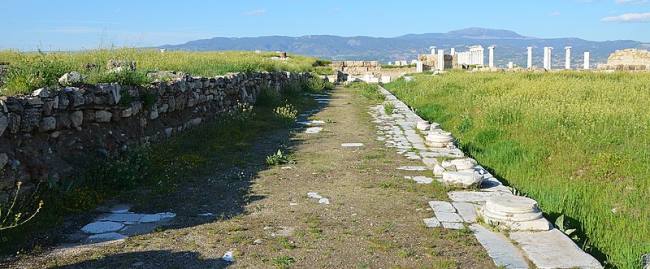
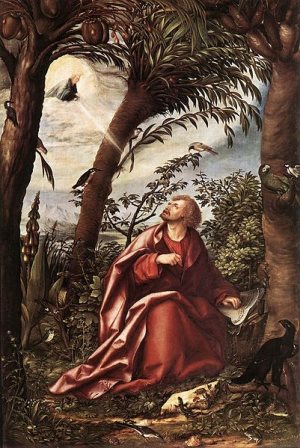
The church of Pergamon (Pergamum) is the third of the seven churches of Revelation, addressed in Revelation 2:12–17. Its acropolis rises above modern Bergama in İzmir province and is a UNESCO World Heritage Site. The letter calls the city the place "where Satan’s seat is" and names Antipas, the only martyr named in all seven letters. Gezginol Tours, a TÜRSAB-licensed travel agency in Kuşadası beside Ephesus, runs guided visits to the Pergamon acropolis with priority-pass entry; site tickets are paid separately, at cost.
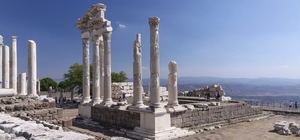
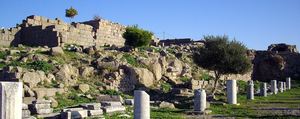
Among all the strange phrases in the seven letters, none is stranger than the one sent to the third church: "I know... where thou dwellest, even where Satan's seat is." Pergamon had been the royal capital of the Attalid kings, who ruled much of western Asia Minor from this hill, and its acropolis is still the most theatrical site of the seven — a steep hill rising more than three hundred meters above the modern town of Bergama, crowned with the ruins of temples, a library, and a theater cut almost vertically into the slope.
The Royal City
Before Rome, Pergamon was the seat of the Attalid kings, and they made it one of the great cultural centers of the Hellenistic world. Its library held, by ancient report, two hundred thousand scrolls — second only to Alexandria. The rivalry was real enough that when Egypt cut off the supply of papyrus, Pergamon perfected the treated animal skin we still call parchment — a word that simply means "the thing from Pergamon."

On the acropolis stood the Great Altar of Zeus, built around 165 BC, its base wrapped in an enormous sculpted frieze of gods fighting giants. Below the city spread the Asclepion, one of the most famous healing sanctuaries of the ancient world, where the physician Galen — born in Pergamon — learned his craft. And in 29 BC the city achieved something no other had: it built the very first temple of the imperial cult in the Roman East, dedicated to Rome and the emperor. Pergamon was, in a real sense, the official religious capital of the province.
Where Is the Throne of Satan Today?
The throne of Satan named in Revelation 2:13 stood on the acropolis of Pergamon, above modern Bergama in İzmir province, western Turkey — today a UNESCO World Heritage Site. The Great Altar of Zeus that most scholars identify with it was carried off to Berlin in the nineteenth century and stands in the Pergamon Museum; its foundations remain on the hilltop, open to visitors.
So when the letter calls Pergamon the place "where Satan's throne is," it is spoiled for choice. Scholars have proposed three candidates, and we think all three are partly right.
It could be the Altar of Zeus, the great throne-shaped structure that loomed over the whole city — the altar itself was carried off to Berlin in the nineteenth century, where it stands today in the Pergamon Museum, but its foundations still sit on the height, and our post on the Pergamon Altar in Berlin tells how it got there. It could be the imperial cult, which made this city the center of emperor-worship for all of Asia. Or it could be the Asclepion, whose healing god was symbolized by a serpent coiled on a staff — an image early Christians readily linked to the serpent of Eden.

Honestly, we think the phrase means the whole of it. Pergamon was the most concentrated mass of organized pagan power in the province — altar, emperor, and healing-god together. "Satan's throne" is not one building. It is the entire dense religious atmosphere that pressed in on a tiny Christian congregation living in its shadow.
The Sword
Christ introduces himself to this city as the one "which hath the sharp sword with two edges." That is not a random image. As a Roman provincial capital, Pergamon was a seat of the governor's authority, including the ius gladii — the right of the sword, the legal power of capital punishment. The sword was the very emblem of Roman justice here. So Christ holds up another sword, sharper than the governor's: the sword of his word. Two swords in Pergamon, and the Christians would have caught the comparison at once.
Antipas of Pergamum, Remembered by Name
Antipas of Pergamum is the Christian whom Revelation 2:13 calls "my faithful martyr," killed in the city some time before the letter was written. He is the only martyr the Book of Revelation names, and in the King James Version only one other person in the whole Bible is called by name a martyr: Stephen, in Acts 22:20.
Thou holdest fast my name, and hast not denied my faith, even in those days wherein Antipas was my faithful martyr, who was slain among you, where Satan dwelleth.
Here is the one martyr named in all seven letters. We know almost nothing else about Antipas — later tradition makes him the bishop of Pergamon and tells a grim story of execution inside a heated bronze bull, but those details come centuries later. What the text tells us is simple and enough: there was a man named Antipas; the community knew him; he was killed for the faith; and the church did not deny the name even so.
We find this small detail deeply moving. In a city of kings and emperors and a two-hundred-thousand-scroll library, in an ocean of historical fame, Christ remembers the name of one ordinary man who was killed. Not the kings. Not the famous physician. Antipas.
Look closely at the title he is given, too. The Greek martys meant a witness before it came to mean someone who dies for the faith, and "my faithful martyr" is almost word for word the title Revelation gives Christ himself in its opening chapter, "the faithful witness" (Revelation 1:5). The man remembered by name is honored with his Lord's own description. The Eastern churches still keep his feast on April 11. The details of his death belong to that later tradition; the title belongs to the text itself.
The Warning: The Doctrine of Balaam
But Pergamon also gets a rebuke, and a sharp one. Inside this brave congregation, some held "the doctrine of Balaam" — and to read it you have to know the old story. In the Book of Numbers, the prophet Balaam, unable to curse Israel outright, advised their enemy to corrupt them instead: send them to the pagan banquets, the sacrificial meals, the loose festivals, until they lose what makes them distinct.
That is the exact charge here. A group inside the Pergamene church was teaching that Christians could attend the pagan banquets, eat the sacrificed meat, share in the surrounding culture's appetites — the idols are nothing, so relax. It is the same compromise we will meet again at Thyatira. And the letter draws a hard line: there is a place where freedom stops, and the temple banquet is past it. "Repent; or else I will come unto thee quickly, and will fight against them with the sword of my mouth."
Notice the precision of the threat, though. Christ does not threaten the whole community. He targets the false teachers specifically. The faithful are not collectively punished for the corruption in their midst. Even in a compromised church, the honest believer is still seen as faithful.
Hidden Manna and a White Stone
The promise to the overcomer is double and mysterious: "I will give to eat of the hidden manna, and will give him a white stone, and in the stone a new name written, which no man knoweth saving he that receiveth it."
The hidden manna recalls the jar of desert bread kept in the lost Ark — in Jewish hope, the secret food of the coming age, the meal of the kingdom. The white stone has several echoes: the white pebble of acquittal dropped by a Roman juror, the white token that admitted a victor to the banquet, the inscribed stone of an amulet. Whatever the exact reference, the meaning is clear enough — against the public banquets of the idols, the faithful are promised a different invitation, a private name, a meal that no compromise could ever buy.
Stand on the upper terrace of the acropolis on a windy afternoon, with Bergama small and quiet in the valley below and the wind moving through the pines, and you can almost see the first Pergamene Christians somewhere down in the lower town, hearing this letter for the first time — the praise for their courage when Antipas died, the warning about the teachers in their own house, the promise of the white stone. The letter did its slow work. The church survived for centuries. The stones, in their quiet way, were given.
Pergamon Among the Seven Churches
Pergamon is the northern turning point of the circuit, about a hundred kilometers up the coast from Smyrna and roughly the same again from Ephesus. From here the road leaves the sea and climbs inland to Thyatira, the nearest of the others at around seventy-five kilometers by road, and on to Sardis. Pergamon's natural partner among the seven is Thyatira: both were warned about the same thing, the teachers who urged Christians to eat at the pagan banquets. And like Smyrna, Pergamon knew real martyrdom in the death of Antipas. It stands a long way, in every sense, from comfortable Laodicea at the far end of the loop. The rest of the loop is covered in our full set of seven churches articles, and our Seven Churches of Revelation tour walks all seven in order.
Gallery

Sources & Further Reading
- Pergamon — UNESCO World Heritage Centre — the multi-layered landscape of the acropolis
- Pergamon Altar — Wikipedia — the great altar, now in Berlin
- Revelation 2:12–17 (KJV) — the letter to Pergamon
- Antipas of Pergamum — Wikipedia — the one martyr named in the seven letters