The church of Ephesus is the first of the seven churches of Revelation, addressed in Revelation 2:1–7. Its ruins lie beside modern Selçuk in İzmir province, western Turkey — the best-preserved ancient city in the Mediterranean and a UNESCO World Heritage Site. The letter praises the congregation’s hard work and doctrinal vigilance, then delivers the warning it is remembered for: "thou hast left thy first love."
Our home base of Kuşadası is a short drive down the coast from the gates of ancient Ephesus, and our guides walk its marble streets most working days of the season. So we will not pretend to be neutral about the first of the seven churches. Of all of them, Ephesus was the greatest — the largest, the earliest, the most influential — and its letter is the one we find hardest to read aloud without it turning around and looking back at the reader.
The First City of Asia
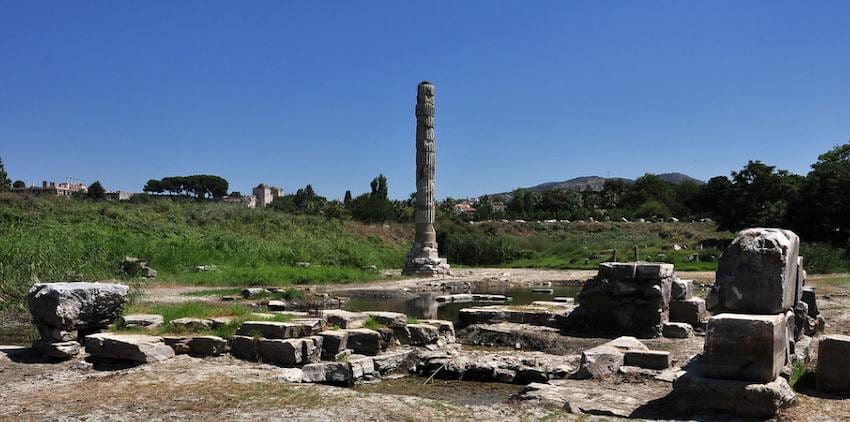
Ephesus was already a thousand years old when Paul arrived. It was the metropolis of the Roman province of Asia, a harbour city whose population may have reached a quarter of a million. Its Temple of Artemis was one of the Seven Wonders of the ancient world — about four times the size of the Parthenon, with more than a hundred columns nearly twenty metres high. Pilgrims and traders came from across the Mediterranean to the goddess the city called simply "the Lady of Ephesus."

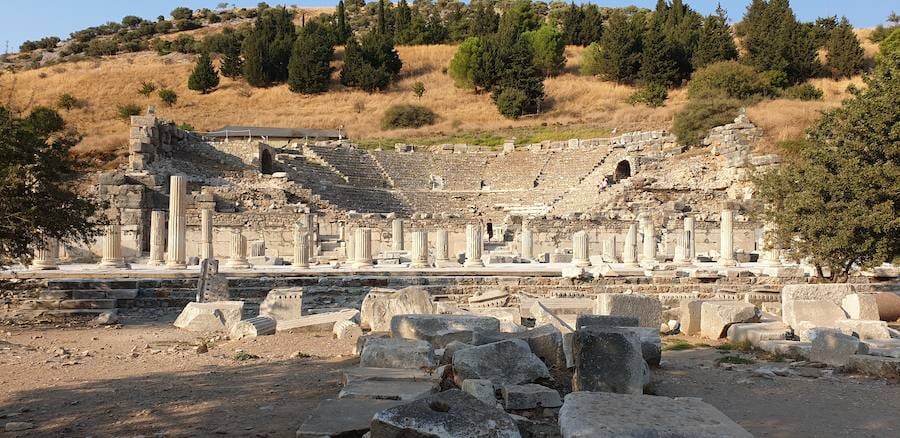
Into this city Paul came, around the year 52, and on his return he stayed nearly three years — the longest he ever remained anywhere. He taught daily in the hall of a man named Tyrannus, and the message spread through the whole province. It was disruptive enough that the silversmiths, whose trade depended on selling shrines of Artemis, started a riot. The crowd poured into the Great Theatre and chanted "Great is Artemis of the Ephesians!" for two solid hours. That theatre still climbs the slope of Mount Pion today; it held twenty-five thousand people, and you can sit on its stone and read Acts chapter 19 where it happened.

After Paul came John, and with him, by the strong local tradition, Mary the mother of Jesus. Ephesus thus held, within a single generation, more of the first Christian story than almost anywhere outside Jerusalem. This was the senior church. When the seven letters were read in order, Ephesus was addressed first — and inspected most closely.
Walking the City Today
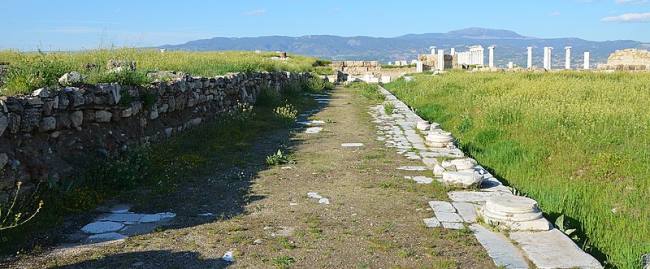
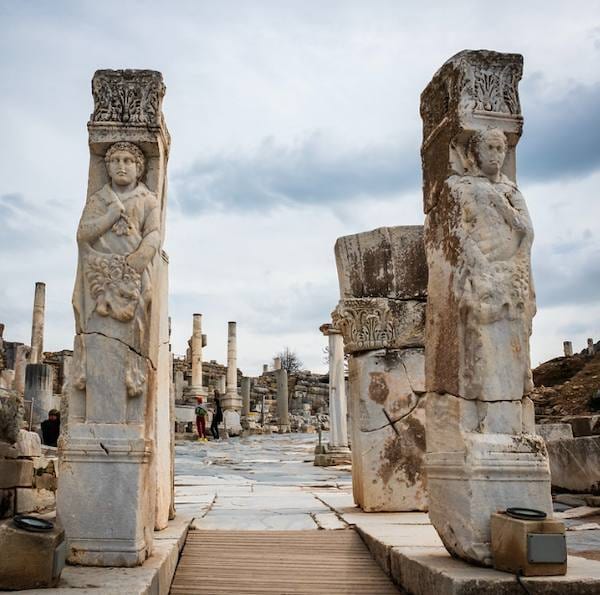
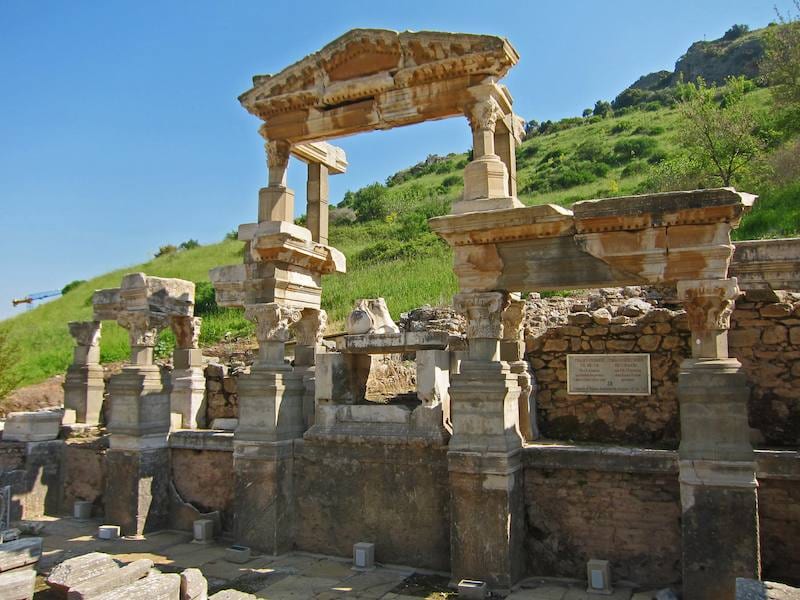
The Ephesus a visitor walks now is one of the best-preserved ancient cities in the Mediterranean, listed since 2015 as a UNESCO World Heritage Site. You come down the marble length of Curetes Street, past the Temple of Hadrian and the terraced houses of the rich, to the façade of the Library of Celsus — two storeys of columns rebuilt from their fallen pieces, glowing gold in the late afternoon. Below stands the commercial agora, where the early congregation likely had its workshops, including the tent-making trade that supported Paul.

Above the ruins, on the hill of Ayasuluk in modern Selçuk, are the ruins of the Basilica of Saint John, built by the emperor Justinian over the apostle's tomb — once one of the largest churches in the entire Byzantine world. I will return to that hill at the end, because it turns out to matter for the letter.
The Letter: Correct, Hard-Working, and Cold
The letter opens with Christ "who walketh in the midst of the seven golden candlesticks" — inspecting, like a master moving through his garden, deciding which plants are healthy. Then comes a long line of praise, and it is genuine: "I know thy works, and thy labour, and thy patience... and thou hast tried them which say they are apostles, and are not, and hast found them liars." The Ephesians were tireless, doctrinally careful, and hard to fool. When false teachers came through, the Ephesians tested them and turned them away. By every external measure, this was a model church.
Nevertheless I have somewhat against thee, because thou hast left thy first love.
That single sentence is the whole letter. The Greek verb means to let go of something you once held — and what had slipped from their grasp was the warmth of the beginning. They still did everything right. They still kept out the frauds. But the fire that brought them together — love for Christ, for one another, for the outsider — had cooled into mere correctness. The doctrine was pure. The heart had gone quiet.
We find this the most sobering diagnosis of all seven, precisely because Ephesus had every advantage: apostolic founders, sound teaching, serious leadership, everything in order. If this church could lose its first love, no congregation — and no believer — is safe from the same slow cooling.
The Cure, and the Warning
The remedy comes in three short commands: "Remember therefore from whence thou art fallen, and repent, and do the first works." Notice the third one. Not feel the first feelings — you cannot command an emotion — but do the first works. Return to the practices: the hospitality, the prayer, the care for the poor, the brotherly love. Do them, and trust the warmth to follow. The fire went out because the practices were let go; recover the practices, and the fire can be rekindled.
But there is a warning with a sharp edge: "I will... remove thy candlestick out of his place, except thou repent." The lampstand could be taken away — the church could lose its very place among the seven.
And here is the part that gives us a chill every time, standing in the ruins. It happened. Not at once, but over centuries. The harbour silted up, the city shrank, the population drifted away, and the great Christian community of Ephesus slowly dissolved. The candlestick was, in the end, moved. And yet — not entirely. The bishopric simply withdrew up the hill, to that basilica over John's tomb on Ayasuluk. The lampstand was not extinguished. It relocated.

The Tree of Life
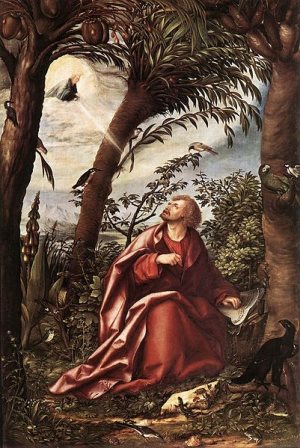
The letter ends with the first of the seven great promises: "To him that overcometh will I give to eat of the tree of life, which is in the midst of the paradise of God." The image comes straight from the garden of Eden. Humanity was once shut out from that tree. Now, to the one who returns to the first love, it is offered back. The fall is not final. The expulsion is not permanent.
That promise is worth reading often — not only for Ephesus, but for anyone who has felt the early warmth of anything slowly going tepid. Remember. Repent. Do the first works. The lampstand is still movable. The tree is still offered. Next time you stand in the little square before the Library of Celsus, in the slanting evening light, imagine the first Ephesian Christians hearing this letter read aloud and walking home that night asking themselves the one question it forces on every generation since: have I left my first love?
Ephesus Among the Seven Churches
Ephesus is where the circuit begins. Smyrna lies about eighty kilometres north up the coast, and Pergamon beyond it. From there the road turns inland to Thyatira, Sardis, Philadelphia and finally Laodicea, before bending back toward home. Just offshore lies Patmos, where the letters were written. Among the seven, Ephesus has most in common with Laodicea and Sardis: all three were prosperous, established and comfortable, and all three were warned for it. The contrast is sharpest with Smyrna and Philadelphia, the two small, pressured churches that received no rebuke at all.
Gallery





Sources & Further Reading
- Ephesus — UNESCO World Heritage Centre — the official listing of the site
- Acts 19 (KJV) — Paul’s years in the city and the silversmiths’ riot
- Temple of Artemis — Wikipedia — the wonder of the world that defined the city
- Ephesus — Encyclopaedia Britannica — the history of the metropolis of Roman Asia