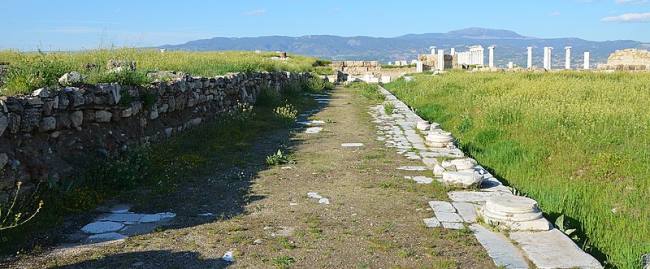
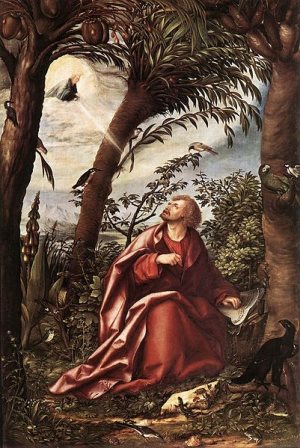
The church of Philadelphia is the sixth of the seven churches of Revelation, addressed in Revelation 3:7–13. Ancient Philadelphia lies under modern Alaşehir in Manisa province, where three brick pillars of a Byzantine basilica still stand. Philadelphia is the second of the two churches to receive no rebuke, and is promised an open door that no man can shut.
Of all seven cities, Philadelphia has the most beautiful name. It is simply the Greek for brotherly love — philos, loving, and adelphos, brother. American visitors are always quietly delighted to learn that the original Philadelphia is not in Pennsylvania but here in western Turkey, inside the modern town of Alaşehir; William Penn's city was named in deliberate memory of this one. And of all seven letters, the one sent here is the gentlest. It contains no rebuke at all — only encouragement, only promise.
A City Built to Be a Door
Philadelphia was a relatively young city, founded in the second century BC by the kings of Pergamon and named for the famous devotion between two royal brothers. Its purpose was specific and strategic: it stood on the frontier between the Greek-speaking coast and the older Phrygian highlands inland, and it was placed there deliberately to act as a gateway — to carry Greek language and culture up into the interior. The city was, by design, a door. Hold on to that, because the letter takes the same image and lifts it to something far greater.
The Shaking Ground
There is one more fact you must feel before you can read the letter properly: Philadelphia sat on one of the most violent fault lines in Asia Minor. The great earthquake of AD 17 destroyed it along with Sardis and a dozen other cities — but unlike the others, Philadelphia went on suffering aftershocks for years. The geographer Strabo, writing not long before Revelation, describes it vividly in his Geography: cracks constantly opening in the walls, most of the citizens refusing to live inside the town at all, sleeping out in the open fields, with only a few stubborn souls remaining within the walls.
So the Philadelphians were a people who knew, in a way most of the empire did not, that the ground under their feet was not safe — that any pillar they raised might shake and fall, that the prudent thing was to keep going out of the city to safety. Every image in their letter answers that exact anxiety.
A Faithful Little Church
Christ introduces himself here as "he that is holy, he that is true, he that hath the key of David, he that openeth, and no man shutteth." The key of David comes from Isaiah — the symbol of authority over the royal household, the power to admit and to refuse. To a small and vulnerable congregation, Christ says: I am the one who holds the master key.
Then, with no rebuke at all, the praise: "I have set before thee an open door, and no man can shut it: for thou hast a little strength, and hast kept my word, and hast not denied my name." That phrase — a little strength — is not a criticism. It is an honest, tender acknowledgment. This was a small church, probably poor, without numbers or influence or powerful leaders. But it had kept the word and not denied the name, and Christ honors it precisely for its faithfulness in weakness.
This is, we think, the most encouraging passage in the whole book for any small congregation, any tiny mission, any handful of believers who feel too few to matter. It does not matter that you are few. It does not matter that you are weak. What matters is that you have kept the word.

The "open door" was a missionary image — in Paul's letters, an open door always means an opportunity to preach. And it was perfectly fitted to this city: Philadelphia had been founded as a gateway for Greek culture into the highlands; now it was given a new mission of the same shape but a greater message — to be the open door for the Gospel to go further inland still.
The Hard Phrase, Again
As at Smyrna, the letter mentions "the synagogue of Satan, which say they are Jews, and are not." And as at Smyrna, we read it carefully and locally. This is not an attack on the Jewish people — the early Christians were largely Jews themselves. It points to a specific local conflict: a small Christian community, many of them probably former God-fearers attached to the synagogue, who had been shut out, excluded, made into religious refugees in their own town. The reply is one of vindication, not triumph: the One who holds the key is opening a far greater door than the one that was closed against them, and in the end the love of God upon this little church will be recognized. It is pastoral comfort to the rejected, not a victory of one group over another.
The Pillar That Will Not Fall
The promise to the overcomer here is one of the richest in the book, and every image of it speaks straight to an earthquake city:
Him that overcometh will I make a pillar in the temple of my God, and he shall go no more out... and I will write upon him my new name.
A pillar in the temple of my God. To people who had watched their pillars crack and fall, who slept in fields for fear of the next tremor — a pillar that will never fall, in a temple that will never shake. He shall go no more out. To people whose lives were a habit of fleeing the city for safety — no more evacuation, ever, because the foundations are eternal. And a new name: Philadelphia kept renaming itself after the emperors who funded each reconstruction, trading its old name for a new imperial one out of dependence and gratitude. Christ promises a different new name — not Caesar's, but the name of God, and of the new Jerusalem, and his own.
Still Standing
Philadelphia earned, over the centuries, a kind of historical confirmation of its letter. It became one of the most stubborn Christian outposts of Asia Minor — the very last city of the region to fall to the Ottoman advance, holding out independently until 1390, long after the empire around it had gone. I have set before thee an open door, and no man can shut it.
And there is a final image we love. In the middle of modern Alaşehir stand a few massive brick pillars of a Byzantine church — broken at the top, the roof gone for a thousand years, the community that built them long scattered. But the pillars are still upright, after fifteen centuries of earthquakes and conquests and abandonment. Him that overcometh will I make a pillar... and he shall go no more out. It is not a metaphor that needs explaining. It is a promise that is, in broken fragments, still being kept — right there, in the center of a small Turkish town, visible from the street.
Philadelphia Among the Seven Churches
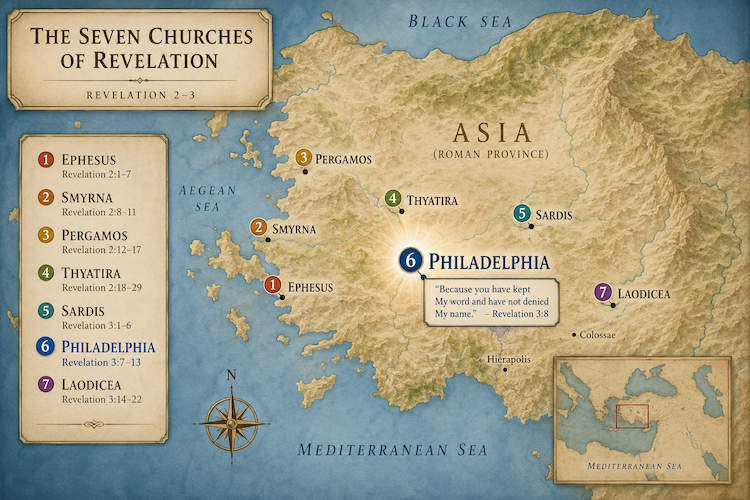
Philadelphia stands inland, about fifty kilometers southeast of Sardis and a hundred or so northwest of Laodicea, the last of the seven before the loop closes. Its truest companion among them is Smyrna: these two small, hard-pressed churches are the only ones John praises without a single word of rebuke. Its sharpest contrast is its near neighbor Sardis, close enough to reach in a day, yet the opposite case, a living church beside a dead one. Like Sardis, Philadelphia knew earthquakes well. Unlike comfortable Laodicea down the road, it had little strength, and was honored for keeping the word anyway. Philadelphia's neighbors on the circuit are covered in our full set of seven churches articles, which our Seven Churches of Revelation tour visits in order.
Gallery

Sources & Further Reading
- Revelation 3:7–13 (KJV) — the letter of the open door
- Strabo — Wikipedia — the geographer who described the city’s earthquakes
- Alaşehir — Wikipedia — the modern town over ancient Philadelphia
- W. M. Ramsay, The Letters to the Seven Churches of Asia (1904) — the classic on-the-ground study of the seven cities