There is a figure in the story of Revelation that almost nobody asks about, and we think that is a small injustice. We talk endlessly about John — the visions, the exile, the eagle, the trumpet voice. But John was an old man on a hard island, dictating one of the longest and densest books in the Bible. Someone had to sit on the cave floor with a board on his knees, dip the reed, and write it all down. Tradition gives that someone a name: Prochorus.
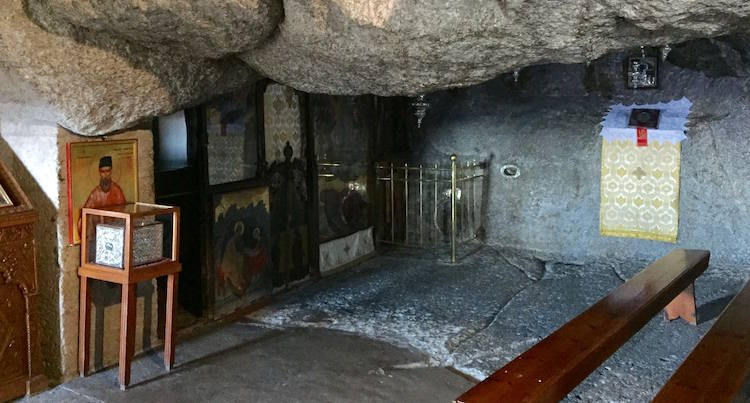
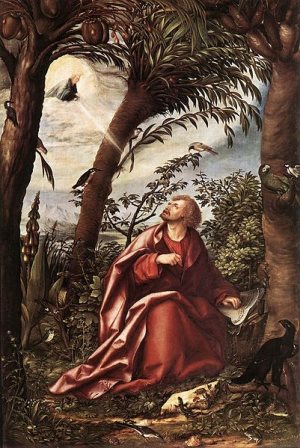
Once you know to look for him, you start seeing him everywhere on this coast. In the old icons and mosaics of the cave on Patmos, John stands with his head turned up toward the light, listening — and below him, smaller, seated, intent, is a younger man writing. That younger man is Prochorus. We have a soft spot for him. The man with the pen rarely gets the credit.
What the Bible Actually Tells Us
Here we have to be careful and honest, because the firm evidence is thin and the tradition is thick — and we would rather you knew which is which.
Prochorus is named exactly once in the New Testament, and it is not on Patmos at all. In Acts chapter 6, the young Jerusalem church is straining under its own growth, and seven men are chosen to serve the community so the apostles can keep to preaching and prayer. The list is short and famous: Stephen first, then Philip, then "Prochorus, and Nicanor, and Timon, and Parmenas, and Nicolas." These are the first deacons. Stephen would become the first martyr; Philip would become a great evangelist. Prochorus is simply a name on the list — one of the seven, and then silence.
That is the whole of the certain record. One verse. A name among seven.
Where the Tradition Takes Him
Everything else comes from later Christian tradition, and the Eastern Church in particular kept his memory alive. In that tradition Prochorus becomes a disciple and travelling companion of John the Apostle, follows him to Asia, shares his exile on Patmos, and serves as his amanuensis — his secretary, the one who physically wrote the text as John spoke it.
There is even a surviving work, the Acts of John by Prochorus, written centuries later and certainly not by him, that tells the story of their time on the island in colourful, legendary detail. No serious historian treats it as fact. But it preserves something the early Church clearly believed and loved: that the Apocalypse was not scratched out by one hand in isolation, but spoken and received between two people — an old visionary and a faithful younger scribe.
The same tradition carries Prochorus onward after Patmos: it makes him bishop of Nicomedia (modern İzmit, not far from Istanbul) and has him die a martyr at Antioch. Whether or not those details are historical, the shape of the life they describe — deacon, disciple, scribe, bishop, martyr — is the shape of a whole generation of these early servants of the Church.
Why a Scribe Was No Small Thing
People underestimate what it meant to "take down" a book in the first century, so let us put it plainly, because it is the part we find genuinely moving.
Writing was slow, physical, expensive work. The scribe prepared the reed pen and the ink, smoothed the papyrus or parchment, and wrote in a cramped hand while someone dictated — often re-reading lines back, correcting, copying the whole thing out again clean. Revelation is twenty-two chapters of dense, image-soaked Greek, thick with echoes of the Hebrew prophets. To get that down accurately, from dictation, on a remote island, was a feat of patience and skill. The visions may have been John's. The book, as an object that could be wrapped, sealed, and carried to the mainland, owed a great deal to whoever held the pen.
Write the things which thou hast seen, and the things which are, and the things which shall be hereafter.
That command, near the start of Revelation, is given to John. But somebody had to act on it, letter by letter. It is easy to imagine the two of them in the cave near Skala — John pausing, searching for the next image; Prochorus waiting, pen lifted, then writing as the words came. It is one of the quietest, most human pictures in the whole tradition.
The Unsung Helpers
We will admit this article is partly personal to every guide on our team. After years of guiding, we have come to believe that most of the good in the world is done by people whose names never make the plaque — the second name on the list, the one writing while someone else speaks. Prochorus is, for us, the patron of all of them.
When we take groups across to Patmos and stand at the cave, everyone naturally thinks of John. Our guides always point, gently, to the corner of the icon where the younger man sits with his board and his pen, and ask them to remember him too. The book that closes the Bible came to us, the tradition says, through a partnership — and the partner we forget was the one doing the writing.
If you would like to stand in that cave yourself, it is a short crossing from this coast; there is more about the island and the writing of the book in our piece on Patmos and in the short guide to the Book of Revelation. And if you would like guides who have made that crossing many times, our Patmos day tour does exactly that — or simply contact us.
Gallery



Sources & Further Reading
- Acts 6:1–7 (KJV) — the choosing of the seven deacons
- Prochorus — Wikipedia — the deacon and traditional scribe of John
- Seven Deacons — Wikipedia — the seven chosen in Jerusalem
- Acts of John — Wikipedia — the later legendary traditions about John and his circle