A seven churches of Revelation sermon series fits naturally into eight Sundays: one week on John's vision of Christ in Revelation 1:9–20, then one week for each letter in the order the book gives them, from Ephesus to Laodicea in Revelation 2 and 3. The letters run from four to twelve verses, so one letter fills one sermon without strain.
Our guides walk all seven sites with visiting groups, so each week below also carries one detail from the ground and a photograph of what survives there, ready for the screen behind the preacher.
How to Plan a Seven Churches of Revelation Sermon Series
Sermons on the seven churches of Revelation get easier once the shared pattern has been preached. Each letter opens with a title for Christ, most of them drawn from the vision in chapter 1, then "I know thy works," praise, a fault named, a call to repent or hold fast, and a promise "to him that overcometh," sealed with "He that hath an ear, let him hear what the Spirit saith unto the churches." Smyrna and Philadelphia receive no rebuke; Laodicea receives no praise. Our introduction to the seven letters sets out the pattern, and the closing promises have an article of their own.
Week 1: The Voice Behind the Letters (Revelation 1:9–20)
Theme: before Christ corrects his churches, he shows himself standing among them. John, on Patmos "for the word of God, and for the testimony of Jesus Christ," saw one like the Son of man among seven golden candlesticks, holding seven stars, which verse 20 explains as the seven churches and their angels. Most of the letters borrow their opening words from this scene, as our article on the opening vision of Revelation shows. Put our map of the seven churches on the screen too: the letters follow a messenger's loop of Roman road.

Week 2: Ephesus and the First Love (Revelation 2:1–7)
Theme: hard work and sound doctrine cannot stand in for love. This church tested false apostles and hated the deeds of the Nicolaitans, yet heard "thou hast left thy first love." The remedy is three verbs: remember, repent, do the first works. From the ground: Paul had spent three years in Ephesus (Acts 20:31), so this letter reached a second-generation church some forty years later. It is a natural Sunday for faith that has been inherited rather than found.

Week 3: Smyrna, Faithful Unto Death (Revelation 2:8–11)
Theme: suffering is not proof that God has gone. In four verses, without a word of rebuke, Christ names the church's tribulation and poverty, "but thou art rich," and promises: "be thou faithful unto death, and I will give thee a crown of life." From the ground: Smyrna is İzmir today, still a great port city. Around AD 155 its aged bishop Polycarp was put to death there, and the congregation's own account, the Martyrdom of Polycarp, still survives.
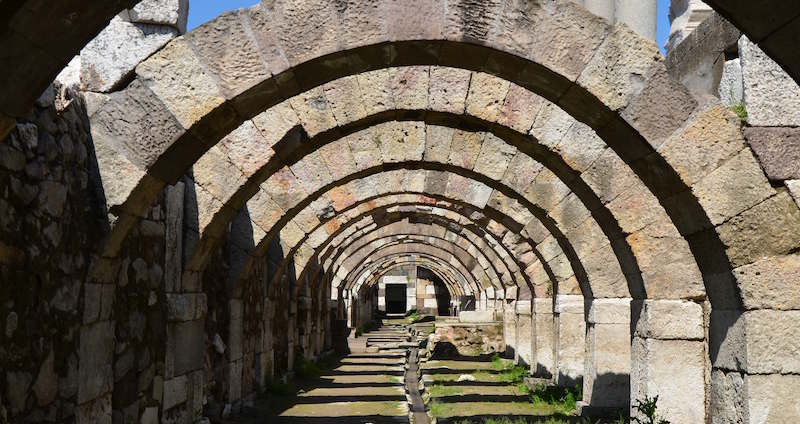
Week 4: Pergamon, Where Satan's Seat Is (Revelation 2:12–17)
Theme: courage outside does not guarantee purity inside. The church held fast "even in those days wherein Antipas was my faithful martyr," yet made room for the teaching of Balaam and of the Nicolaitans. From the ground: Pergamon, once a royal capital, was crowded with temples, among them temples of the emperor cult, and interpreters still debate which one "Satan's seat" means; our article on the false teachers of the seven churches helps with this week. The promise is hidden manna and a white stone with a new name.

Week 5: Thyatira and What a Church Tolerates (Revelation 2:18–29)
Theme: growing love and service do not excuse tolerated error. Here the "last works" were more than the first, the reverse of Ephesus, yet the church allowed "that woman Jezebel" to teach. From the ground: Lydia, whom Paul met in Philippi, was "a seller of purple, of the city of Thyatira" (Acts 16:14). The town's working life ran through trade guilds, and many preachers link the warning about food sacrificed to idols with the meals a guild member was expected to share.

Week 6: Sardis, a Name Without Life (Revelation 3:1–6)
Theme: a reputation is not a pulse. "Thou hast a name that thou livest, and art dead," then "Be watchful," and the warning that Christ will come "as a thief." From the ground: the citadel of Sardis twice fell to attackers who climbed a cliff its defenders thought no one could scale, so its people knew what an unwatched wall cost. The slide shows the small brick church at the southeast corner of the Temple of Artemis, which the Sardis excavation team dates to the later fourth century. End with the "few names even in Sardis" who would walk in white.

Week 7: Philadelphia and the Open Door (Revelation 3:7–13)
Theme: little strength is enough when Christ holds the door. "I have set before thee an open door, and no man can shut it: for thou hast a little strength, and hast kept my word." There is no rebuke, and the overcomer becomes "a pillar in the temple of my God, and he shall go no more out." From the ground: the geographer Strabo, writing a few decades before the letter, says the walls of the houses there cracked incessantly in the tremors, so few people lived in the city and most farmed the country around it. A pillar that never moves meant something there, and the slide for this week shows pillars that are still standing in the middle of Alaşehir.

Week 8: Laodicea, Neither Cold nor Hot (Revelation 3:14–22)
Theme: comfort can hide need. The church said "I am rich, and increased with goods, and have need of nothing," and was counseled to buy gold tried in the fire, white raiment and eyesalve. Then comes the verse to end the series on, "Behold, I stand at the door, and knock," spoken to the one church that heard no praise. From the ground: Laodicea piped its water in from springs outside the city, and many preachers read "lukewarm" against that supply, between the hot springs of Hierapolis and the cold water of Colossae.

A Bible Study on the Seven Churches, Week by Week
The same plan serves a small group. Read the letter aloud and ask what Christ calls himself, what he praises and corrects, and what he promises. Every refrain speaks to "the churches" in the plural, so each letter was meant for all seven, and a group can fairly ask which one it would have received. More background for each week's stop is on our blog.
Frequently Asked Questions
How many weeks should a seven churches of Revelation sermon series be? Eight: one week on the vision in Revelation 1 and one for each letter. A seven-week series can begin with Ephesus, and a ninth week could close on Revelation 4, where "a door was opened in heaven" straight after the letters.
What was the message to the seven churches? Each church received its own diagnosis, but all seven heard that Christ knows their works, calls them to repent or hold fast, and promises life to whoever overcomes.
What do the seven churches represent? First of all, seven real congregations in the Roman province of Asia, each addressed about its own city and trials. Because every letter ends with a call to hear what the Spirit says "unto the churches," they have always been read as a message to every church as well. Some readers also see seven ages of church history in them, a reading our post on the seven churches of Revelation time periods looks at.
What lessons from the seven churches apply today? Love alongside hard work (Ephesus), faithfulness under pressure (Smyrna), no compromise with false teaching (Pergamon and Thyatira), life behind the reputation (Sardis), faithful use of small strength (Philadelphia) and an honest look at need beneath comfort (Laodicea).
Can a church group visit the seven churches of Revelation today? Yes. All seven sites lie on one road loop in western Turkey, which our Seven Churches of Revelation tour follows in the order of the letters. We buy the entrance tickets in advance so groups skip the queue; the admission fees are paid separately.