In Christian tradition, John the Evangelist is the Galilean fisherman and son of Zebedee, the disciple "whom Jesus loved," who was exiled to Patmos around AD 95 and sent the Book of Revelation to the seven churches of Asia. He died at Ephesus around AD 100 and is buried under the Basilica of Saint John on Ayasuluk Hill in Selçuk, Turkey.
Most pages about him start at the Last Supper and end with his Gospel. Our guides meet him from the other end: at the cave on Patmos where the visions are remembered, and at the marble slab on Ayasuluk Hill where his story closes. This is his life as the road to Revelation, from a boat on the Sea of Galilee to the island where he wrote to the seven churches.
Who Was St John the Evangelist?
John was one of the Twelve. Mark's Gospel describes Jesus calling him and his brother James from their father's boat, where they were mending nets, and the two left Zebedee "in the ship with the hired servants" to follow him (Mark 1:19-20). Luke adds that they were partners of Simon Peter in the fishing trade. Jesus gave the brothers a nickname, Boanerges, "sons of thunder," and with Peter they formed the small inner circle that was present at the Transfiguration and was taken further into Gethsemane than the others.
The Fourth Gospel never names John. It speaks instead of "the disciple whom Jesus loved," who leaned on Jesus at the Last Supper, stood at the cross, and was told to take Mary as his own mother (John 19:26-27). From the second century the Church identified that disciple with John, son of Zebedee, and the same John with the author of the Gospel, three letters and Revelation. That is why the evangelist John, the apostle John, the beloved disciple and John of Patmos are one person in most Christian art and liturgy.
From Jerusalem to Asia
After the resurrection, the Book of Acts places John at Peter's side: at the temple gate, before the council that called them "unlearned and ignorant men," and on the mission to Samaria. Paul names him, with Peter and James the brother of Jesus, as one of the three "pillars" of the Jerusalem church (Galatians 2:9). His own brother James was the first of the Twelve to die, put to the sword by Herod Agrippa around AD 44.
Which apostle went to Asia? The early answer is John. Eusebius, writing about 300, records the tradition that when the apostles divided the world among them, Asia, the Roman province on Turkey's Aegean coast, fell to John. No source says exactly when he moved there. Irenaeus of Lyon, who as a boy heard Polycarp preach in Smyrna, says John published his Gospel while living at Ephesus, and many historians place the move in the decades after the Jewish revolt of AD 66 to 70. By the end of the century he was the senior figure among the churches of Asia, the same seven communities the letters of Revelation address, from Ephesus north to Pergamon and inland to Laodicea.
Exile on Patmos Under Domitian
Revelation names its own setting. Its writer calls himself "your brother, and companion in tribulation," and says he was on the island called Patmos "for the word of God, and for the testimony of Jesus Christ" (Revelation 1:9). The book does not name the emperor. Irenaeus does: the vision, he writes, was seen near the end of Domitian's reign, which ended with the emperor's murder in September 96. Eusebius repeats it and says John was banished to the island under Domitian. Tertullian adds a darker story, that John was first plunged into boiling oil at Rome and came out unharmed; it is told as a legend even by people who love it.
Patmos lay in the same Roman province as the seven cities, a small island off this coast. What the exile looked like day to day, and why it was a confinement rather than a prison, is the subject of our article on Patmos, the island where the vision was written. Here the point is what John did there. He was told: "What thou seest, write in a book, and send it unto the seven churches which are in Asia." The book opens with seven short letters to seven named congregations, each one a city our guests can still stand in.
How Long Was John on the Island of Patmos?
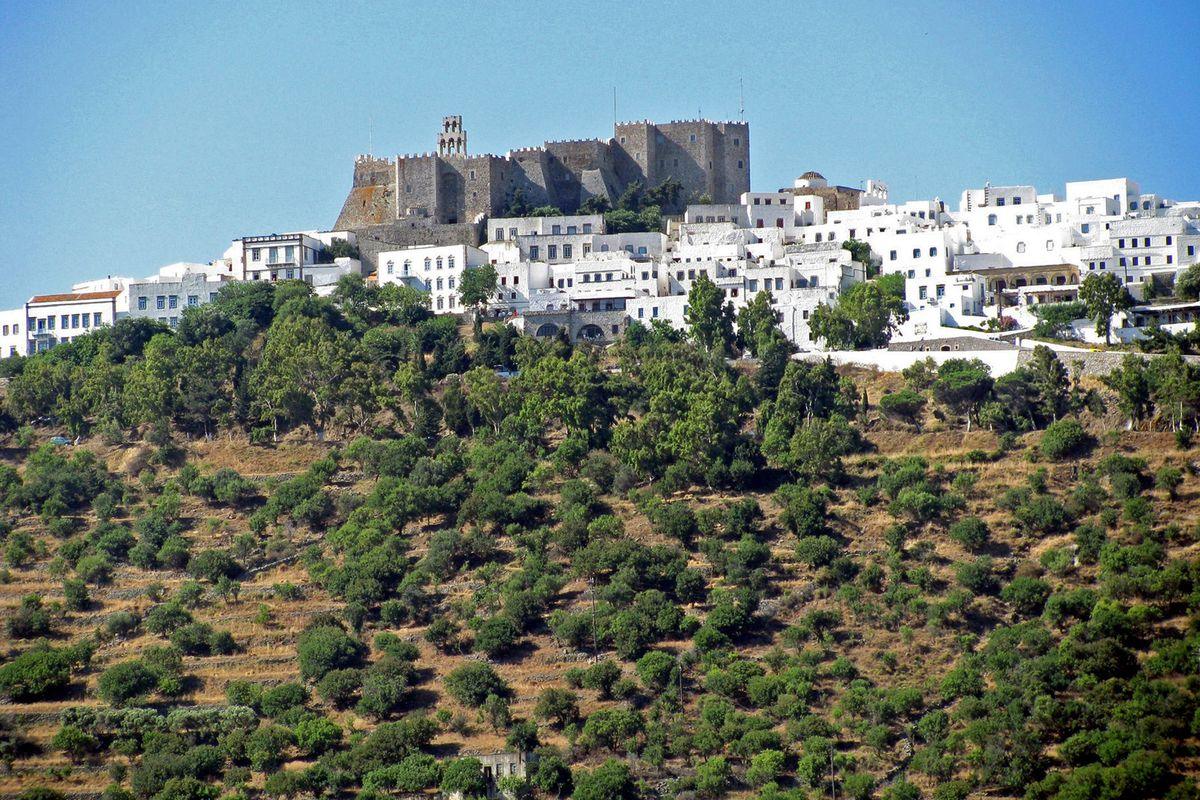
No ancient source gives a number. If he was sent there around 95, as the tradition implies, and freed after Domitian's death in September 96, he spent well under two years on Patmos. Eusebius says that under Nerva, Domitian's successor, John came back from the island and took up his home at Ephesus. The Byzantine tradition kept the memory of the place: in 1088 the monk Christodoulos founded the fortified Monastery of Saint John on the summit, and the cave below it became a chapel. Both are now part of a UNESCO World Heritage Site.

Inside the cave, pilgrims are shown a hollow in the rock framed in silver, where tradition says the old man rested his head, and a handhold in the wall where he pulled himself up. Who held the pen while he dictated is a separate tradition, and we tell it in our article on Prochorus of Patmos.

Did John Write Both the Gospel and Revelation?
The writer of Revelation calls himself simply John, four times, and never "apostle." Early writers such as Justin Martyr and Irenaeus took him to be the apostle. In the third century Dionysius, bishop of Alexandria, noticed how different Revelation's rough Greek is from the Gospel's, and suggested another John wrote it; Papias had already mentioned a "John the Elder" in Asia. Scholars still divide over the question. Tradition, and this site, call the seer John, and the case on each side is set out in our short guide to the Book of Revelation.
Did John the Apostle Die in Ephesus?
The early sources agree that he did. Irenaeus writes that John stayed with the church at Ephesus until the time of Trajan, who became emperor in AD 98. Clement of Alexandria tells how, back from the island, John traveled the surrounding towns appointing bishops and setting churches in order, and Eusebius preserved the story. Jerome, around 392, says he died worn out by old age in the sixty-eighth year after the Passion and was buried near the city (De Viris Illustribus, chapter 9). Unlike his brother and most of the Twelve, he is remembered as the apostle who was not martyred.
The strongest witness to the grave itself is local. Around 190, Polycrates, bishop of Ephesus, wrote to the bishop of Rome listing the great Christians buried in Asia, and among them was John, "who leaned on the Lord's breast," who sleeps at Ephesus. That is about ninety years after John's death, from the bishop of the church that kept his tomb.
Where Is John the Apostle Buried?
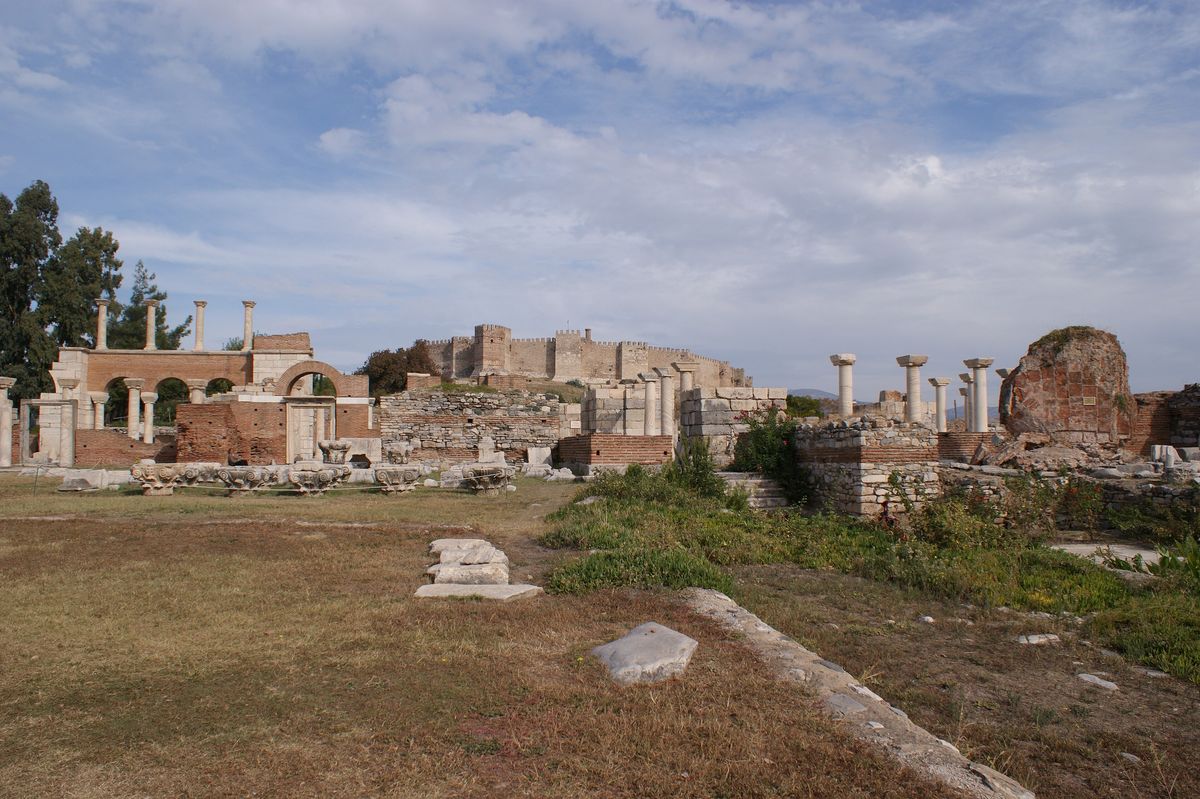
John the Apostle is buried, by a tradition recorded around AD 190, on Ayasuluk Hill in Selçuk, Turkey, beside the ruins of ancient Ephesus. His grave lies under the ruined Basilica of Saint John, which Emperor Justinian rebuilt over it in the sixth century. A marble slab between four columns marks the spot today.

A small memorial church stood over the grave by the fourth century. Justinian replaced it with a vast domed basilica in the shape of a cross, and the tomb lay under its central dome. Pilgrims came for centuries and took home dust from the grave, which was believed to heal. No relics are shown there today; medieval tradition held that the grave was found empty when it was opened. What you find is the marble platform, the four columns and the outline of the great church around it, with the fortress above and the plain of Ephesus below. The Basilica of Saint John is the last stop on John's road and the first stop for many readers of the letter to Ephesus, the church Revelation addresses first.
Seeing Both Ends of John's Story
John's story has two ends, the cave on Patmos and the tomb on Ayasuluk Hill. Our Seven Churches and Patmos tour is the one trip of ours that visits both, with the seven cities in between: a day on the island for the Cave of the Apocalypse and the monastery, then Ephesus and the Basilica of Saint John on the first mainland day, and on around the circuit to Laodicea. From the Kuşadası coast, our Biblical Ephesus Day Tour also stands at the tomb on Ayasuluk Hill. We buy the entrance tickets in advance so you skip the ticket line; the admission fees themselves are paid separately. The full route is drawn on our map of the seven churches, and more posts on Revelation's world are on our blog.
Frequently Asked Questions
Is John the Apostle the same as John the Evangelist? Yes, in Christian tradition. The Church has identified John, son of Zebedee, one of the Twelve, with the evangelist who wrote the Fourth Gospel since the second century. Some modern scholars think the Gospel came from a circle of his disciples, but the names refer to the same saint.
Is John the Evangelist the same as John the Baptist? No. John the Baptist was Jesus' cousin, who baptized him in the Jordan and was beheaded by Herod Antipas before the crucifixion. John the Evangelist was one of the Twelve and lived on into old age at Ephesus.
Who exiled John to Patmos? The Roman emperor Domitian, according to Irenaeus and Eusebius. Revelation itself says only that John was on Patmos "for the word of God, and for the testimony of Jesus Christ."
How old was John on Patmos? No ancient source gives his age. If he was a young man when Jesus called him around AD 28 to 30, he would have been very old by the mid-90s, which fits the early stories of him as the last surviving apostle.
Why is John the Evangelist's symbol an eagle? It comes from the four living creatures around the throne in Revelation 4:7. Christian writers paired them with the four evangelists, and the eagle went to John because his Gospel opens on the highest note: "In the beginning was the Word."
When is the feast day of John the Evangelist? December 27 in the Catholic, Anglican and Lutheran calendars. The Orthodox Church remembers him on May 8 and on September 26, the day it marks his repose.
Can you see John's remains at his tomb in Selçuk? No. No relics are displayed, and medieval tradition held that the grave was found empty when it was opened. Visitors see the marble slab and four columns that mark the tomb inside the ruined basilica.