It is one of the most reasonable mistakes a Bible reader can make. You read Paul's letter to the Colossians, you notice Colossae sitting on the map only a short walk from Laodicea, and you assume it must be in there somewhere — one of the seven churches John addressed from Patmos. It isn't. And the reason it isn't turns out to be one of the more interesting footnotes in the whole story of the seven churches.
The Seven, and the One That Is Missing
The list in Revelation is fixed and specific: Ephesus, Smyrna, Pergamon, Thyatira, Sardis, Philadelphia and Laodicea. Colossae is not on it, even though it was a genuine Christian community with its own New Testament letter and even though it sat only around eighteen kilometers from Laodicea, up the same river valley. Two other nearby towns, Hierapolis and Colossae, both had churches — Paul names all three together in his letter — yet John's book, addressed to congregations scattered across the wider Roman province of Asia, reaches out to only one of them directly.
The Letter That Almost Makes You Forget
The Epistle to the Colossians is where the confusion starts, because it is such a substantial piece of writing — the great meditation on Christ as "the image of the invisible God," written from a Roman prison. Reading it, you would assume Colossae was a major church that Paul knew personally. In fact he almost certainly never set foot in the town. The church there was planted by Epaphras, a local convert who had heard Paul preach in Ephesus and carried the gospel home up the valley; Paul writes to a congregation he loves but has only heard about second-hand.
Colossians itself hints at the real relationship between the three Lycus Valley towns. Near the end, Paul instructs: "And when this epistle is read among you, cause that it be read also in the church of the Laodiceans; and that ye likewise read the epistle from Laodicea." Even in Paul's own lifetime, a generation before Revelation, Laodicea was already the town whose church other communities routed their mail through — the regional hub, with Colossae as its smaller neighbor up the valley.
An Earthquake Decided It
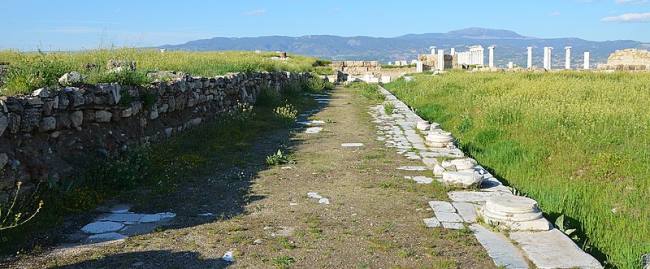
The likeliest explanation for what happened next is not theological at all. It is geological. In AD 60, a severe earthquake struck the Lycus Valley and flattened Laodicea, Hierapolis and Colossae together — the event is recorded by the Roman historian Tacitus in his Annals. Rome offered disaster relief to rebuild. Laodicea, true to the wealth and self-sufficiency that its own letter would later mock, refused the imperial money and rebuilt itself unaided, fast, and impressively. Hierapolis and Colossae accepted the relief funds and recovered far more slowly — Colossae, by most reckonings, took the best part of a century to properly rebuild.
By the time John wrote to the seven churches roughly thirty-five years later, the balance of power in the valley had shifted decisively. Laodicea had grown into a banking center wealthy enough to be told, in the harshest of the seven letters, that its riches had made it spiritually useless. Colossae, still climbing out of the rubble, had become the junior partner. It is easy to imagine that a circulating letter meant for the leading churches of the province simply had no need to add a smaller neighboring town whose congregation Laodicea's could already reach on foot in an afternoon.
What Is There Today
If you go looking for Colossae now, you will not find columns or a theater the way you can at Laodicea or nearby Hierapolis. The site survives as a grass-covered mound beside the modern town of Honaz, its Roman and Byzantine layers still sitting largely undisturbed under the soil. For most of the last two centuries it has been the one major Lycus Valley city that scholars could describe but archaeologists could not properly dig — the theater-shaped depression in the ground was the closest thing to a visible ruin.
That changed only recently. A formal excavation of Colossae finally began, and one of its first discoveries was a large rock-cut necropolis outside the ancient walls — dozens of trough-shaped tombs carved into the travertine, holding the ordinary dead of the town Paul wrote to but never saw. It is a strange thought: the city behind one of the New Testament's great letters is, in archaeological terms, only just beginning to speak.
Visiting the Valley Today
None of this makes Colossae unimportant — it makes it a good reminder of how closely tied together the towns of Roman Asia really were. Laodicea, the church that did make the list, is easy to combine with a look at the wider valley on our Biblical Turkey Grand Tour, which follows the same roads Paul's letter to the Colossians would have traveled to reach its neighbors. For the full geography of why these particular seven towns and not others, our route through western Turkey lays out the whole circuit, and the story of Laodicea's lukewarm water and lukewarm faith makes far more sense once you know it was the valley's success story, not its only church.
Colossae's absence from Revelation, in the end, is not a mystery so much as a snapshot of first-century geography and misfortune: a shared earthquake, two different recoveries, and a letter carrier's route that, thirty-five years later, no longer needed to stop there. More stories like this one are on our blog.