The Pergamon Altar, the marble altar many Bible readers link to "Satan's seat" in Revelation 2:13, stands today in the Pergamon Museum in Berlin, while only its stepped foundation remains on the acropolis above Bergama in western Turkey. German excavators shipped its frieze to Berlin from 1879 onward, and the museum's altar hall, closed since 2014, is due to reopen on June 4, 2027.
Our guides stand on that empty terrace with almost every group that climbs the Pergamon acropolis, and the question we hear there most is a simple one: where did it go? Here is the altar's story, from the hilltop to Berlin, to Leningrad and back, and what you can still see of it in both places. For the letter itself and the other candidates for Satan's throne, read our article on the church of Pergamon.
Where Is the Pergamon Altar Today?
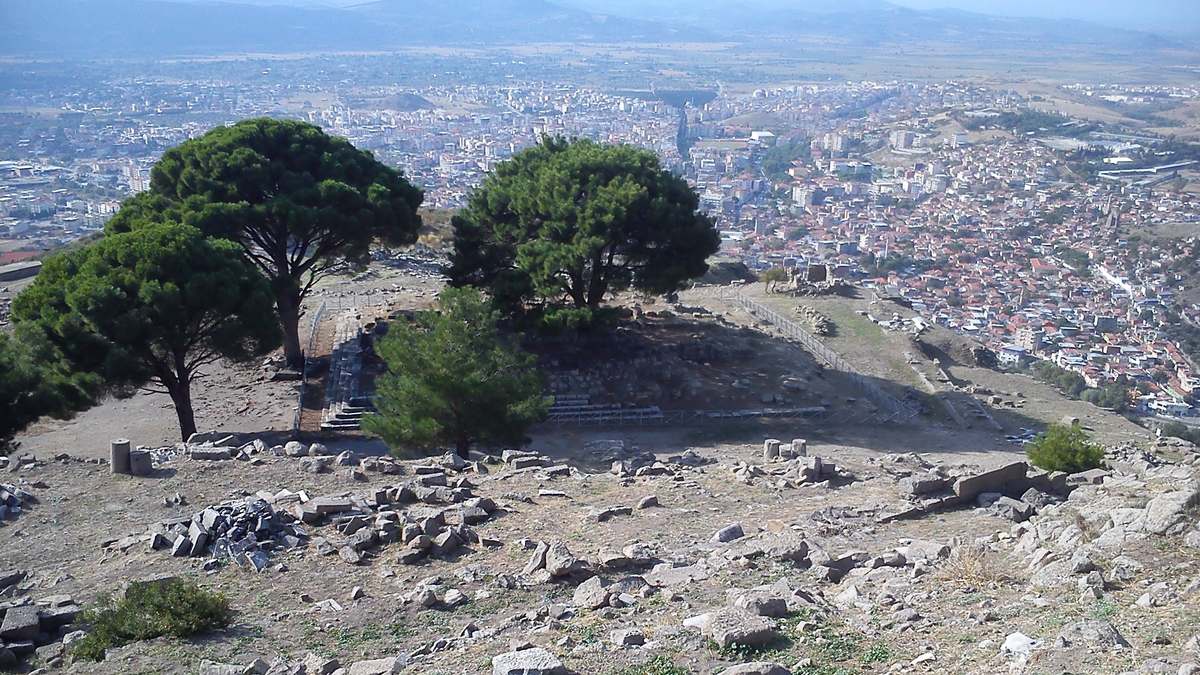
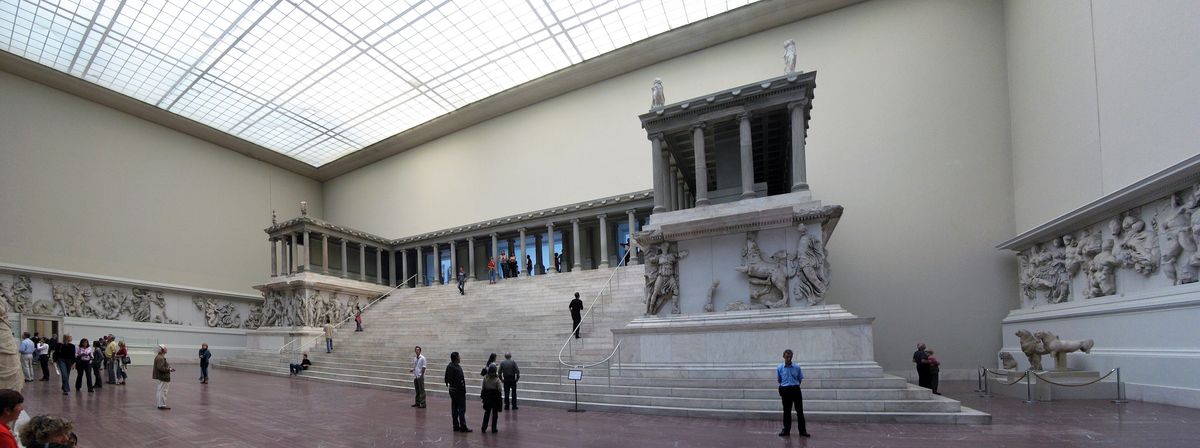
The Pergamon Altar is in Berlin, inside the Pergamon Museum on Museum Island, where its marble frieze is shown around a rebuilt west staircase. The altar hall has been closed for renovation since 2014 and is due to reopen on June 4, 2027. Only the foundation remains at Bergama, Turkey.
What Is the Pergamon Altar?
The altar of Pergamon was built under King Eumenes II in the first half of the second century BC, when Pergamon was the capital of a Hellenistic kingdom. It was not a temple but a colossal open-air altar: a platform about 36 by 33 meters, climbed on its west side by a staircase almost 20 meters wide, with the altar itself in a courtyard at the top. The builders used gray-veined marble from the island of Marmara, according to the Pergamon Altar entry on Wikipedia.
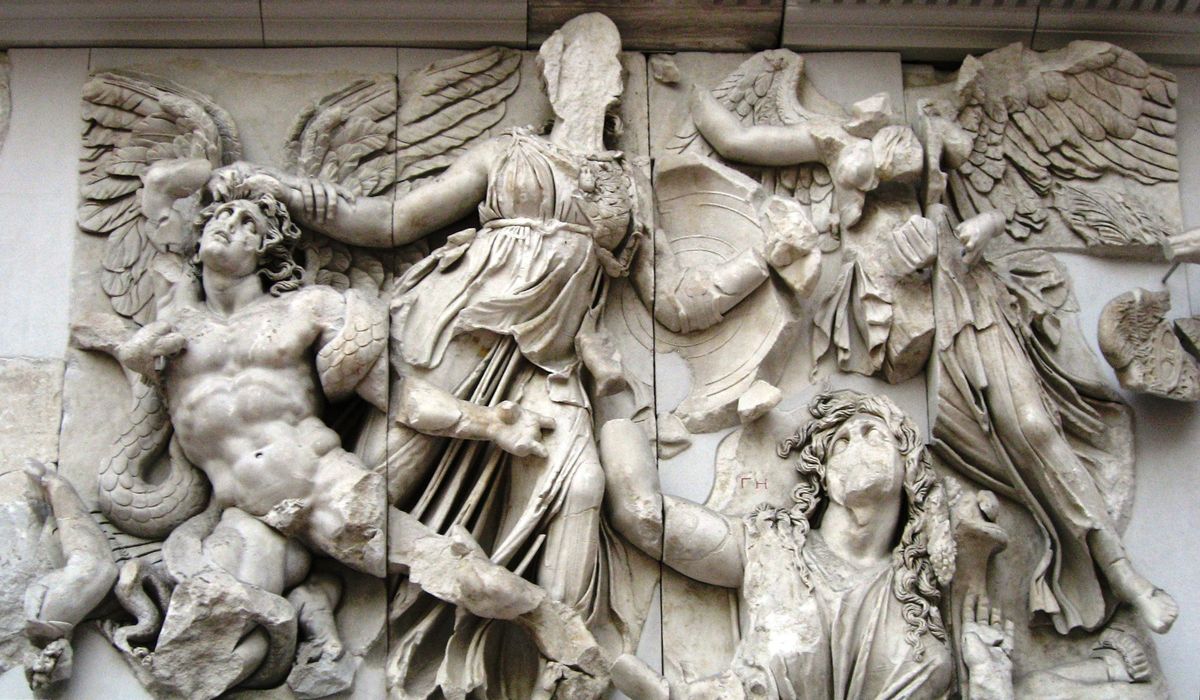
Around the base ran the Gigantomachy, a frieze about 113 meters long and 2.3 meters high showing the gods of Olympus at war with the giants. Inside the courtyard a second, smaller frieze told the life of Telephus, the mythical founder of the city. Who the altar honored is less certain than its popular name suggests. The surviving scraps of inscription are too fragmentary to name the god, and Zeus and Athena are the usual candidates. Scholars are not even sure it received burnt offerings; it may have served only for poured libations.
Why Is the Pergamon Altar in Berlin?
The altar had come down long before any archaeologist arrived. In early Byzantine times, in the seventh or eighth century, it was dismantled and its relief slabs were built into a fortification wall on the acropolis. Carl Humann, a German engineer who supervised road building in Anatolia from 1867 to 1873, first visited Pergamon in the winter of 1864/65 and found local people burning the ancient marble in lime kilns. The carved fragments he sent to Berlin were recognized there as pieces of the great altar.
Official excavations began in September 1878, led by Humann and Alexander Conze for the Berlin museums, and ran until 1886. Under an agreement with the Ottoman government in 1878/79, all finds went to the German Empire for a payment of 20,000 goldmarks, and the relief panels reached Berlin from 1879. Turkish officials have called for the altar's return since the 1990s, and the question is still raised in Berlin today.
In Berlin the frieze first went on show in the Altes Museum. A first Pergamon Museum opened in 1901 as a stopgap, and the present building went up between 1910 and 1930. It does not rebuild the whole altar. The museum reconstructed the west front with its staircase, although the east side was the main face in antiquity, and mounted the rest of the giant frieze on the walls around the hall, with a shortened Telephus frieze at the top of the steps.
Was the Altar of Pergamon Taken to Russia?
Yes, for thirteen years. In 1941, with Berlin under threat of bombing, the frieze was moved to a flak tower near the Berlin Zoo. When the Red Army took the city in 1945, the panels were carried off to the Soviet Union as war trophies and stored in the depot of the Hermitage in Leningrad. They came back to East Berlin in 1958, and the altar went on show again in 1959. That episode is behind the searches for the "throne of Satan in Russia": the stones people call by that name really did spend thirteen years in Leningrad.
The Pergamon Altar and Bible Prophecy
The Bible never names the altar. The letter tells the church at Pergamon that Christ knows where they live, "even where Satan's seat is," and many scholars have argued that the Great Altar, towering over the city, is what John meant. Others point to Pergamon's imperial cult or to the serpent of Asclepius, and our Pergamon article weighs all three. Either way, the line describes the city its first readers lived in. It is not a forecast of where the stones would travel.
The modern chapter that prophecy teachers cite most often is real, though. When Albert Speer designed the grandstand of the Zeppelin Field at the Nazi Party rally grounds in Nuremberg, built between 1935 and 1937, he modeled it on the Pergamon Altar, as the Nuremberg Documentation Center records. Readers draw their own conclusions from that. The letter's own point stands on firmer ground: the church was praised for holding fast "where Satan dwelleth," and then warned about the compromise growing inside it, which our article on the false teachers of the seven churches follows from Pergamon to Thyatira. What that pressure meant day to day for believers in a city like this is the subject of our piece on being a Christian in Roman Asia.
When Does the Pergamon Altar Reopen in Berlin?
The public has not seen the altar in Berlin since 2014. Its hall closed for renovation in September 2014, and the rest of the Pergamon Museum shut in October 2023. The Berlin State Museums have announced that the museum reopens on June 4, 2027, with its North Wing and central building, and that the Pergamon Altar will be on display again from that day. The South Wing is scheduled to follow in 2037.
Until then, a temporary exhibition building at Am Kupfergraben 2, beside Museum Island, pairs Yadegar Asisi's 360-degree panorama of Pergamon as it looked in AD 129 with original sculpture from the Berlin collection. Check its opening hours with the museum before you go.
What You See on the Pergamon Acropolis Today
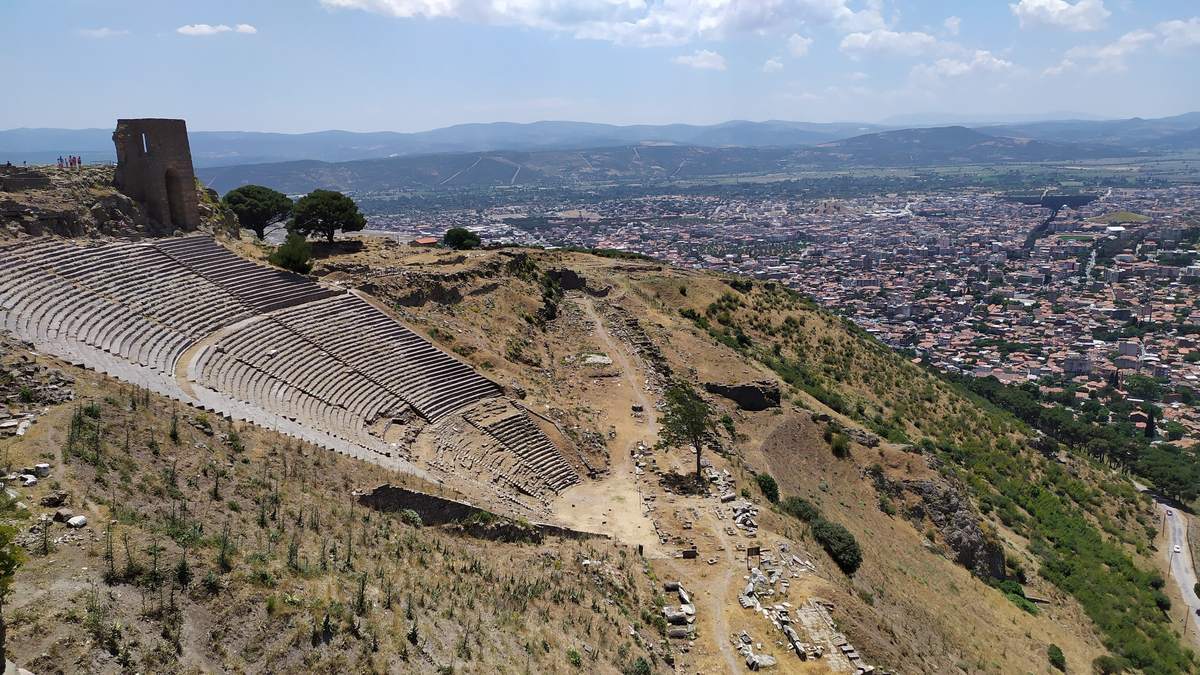
On the hill the altar is gone, but its place is unmistakable. The terrace lies below the sanctuary of Athena, and from above you look straight down on the fenced, stepped foundation with pine trees growing out of it and Bergama spread across the plain beyond. Carl Humann is buried close by: his remains were moved here from İzmir in 1967 and lie just south of the altar. A short walk away, the theater drops down the hillside, one of the steepest in the world.
The altar terrace is part of the Pergamon visit on our Seven Churches of Revelation tour, which takes the cable car up the acropolis. Standing on it, our guides show how the altar was aligned with the temple of Athena above it, how its slabs came to be built into a Byzantine wall, and why a small congregation in the lower town would have felt the weight of this hill when the letter was first read to them. We buy the entrance tickets in advance so you skip the ticket line; the admission fees are paid separately. Pergamon is the northern turning point of the circuit, as our map of the seven churches shows. More on Pergamon and the rest of the seven is on our blog.
Frequently Asked Questions
What is the Pergamon Altar made of? Gray-veined marble from the island of Marmara, the stone Pergamon's builders typically used. The frieze panels in Berlin are that original marble.
What was the Pergamon Altar used for? It was an open-air altar for offerings to the gods, but the details are uncertain. The thighs of sacrificial animals may have been burned on it, or it may have been used only for poured libations.
Is the Pergamon Altar in Berlin real? Yes. The frieze panels are the original carvings of the second century BC, recovered at Pergamon between 1878 and 1886. The architecture around them is a partial reconstruction of the altar's west front, made for the museum that opened in 1930.
Is the altar of Pergamon in the Bible? Not by name. Revelation 2:13 says the church at Pergamon lived "where Satan's seat is," and many interpreters identify that seat with the Great Altar; others prefer the imperial cult or the Asclepion.
Can you visit the place where the Pergamon Altar stood? Yes. The foundation is on the acropolis above Bergama, inside the UNESCO World Heritage Site of Pergamon, and the acropolis can be reached by cable car or by road.